Brew Dudes

Homebrewing Blog and Resource

The hobby of homebrewing beer

Olympic Hops

Looking at the internal search queries, I saw that a good number of people were looking for information about Olympic hops.

I researched for information about the hops and I found some details.  What I didn’t find is anyone selling them.

Plus, the information I found was a little dated.   So I am unsure this post will be helpful in terms of  deciding your next hops purchase but I can give you a good profile of the variety.

Who knows.  Maybe Olympic hops will make a comeback and you will find them available for purchase the next time you visit your local homebrew shop.

Bred by by C. E. Zimmermann in 1974, they are a cross of an unbranded female and male variety. Their makeup spilts out like this:

They were released for public sale in 1983 or 1985 by the Washington Agricultural Experiment Station and the USDA.

Here’s the rest of the breakdown for Olympic:

Origin: USA. Specifically, Prosser, WA

Aroma/Flavor: citrusy aroma, spicy.

Alpha Acid: 11-13%

Typical Usage: Bittering

Beer Styles: American ales, particular pale ales

Substitutions: Chinook

There was one interesting note that I found about this variety. It stated that the hops were adapted to Washington, but they did not produce well in Oregon. They were still being produced in 1997 but not sure if they are any more. I would say go with Chinook if you looking to brew something that is similar to Olympic – for now.

Again, I couldn’t find any for sale at the time of posting. If you know where some can be purchased, please leave a comment below.
For The Love Of Hops

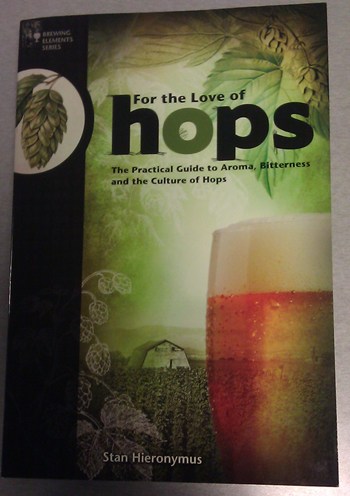
I just bought Stan Hieronymus’ book For the Love of Hops and I haven’t wanted to put it down since.

The book is dedicated “to all of those who have been scratched by the hops” and I think that is a good number of us.

If you have ever dealt with hop bines, you know they can tear up your hands and arms pretty well. You don’t expect it when look at the plant. They don’t have visible thorns. No, hop bines and leaves don’t reveal their damage until after you handle them. A few minutes later, you’ll look at your forearms and hands and you see multiple inflamed red scratches.

Beyond being physically scratched, I think we are also… uh… what’s the word…? emotionally scratched by them too.

A great many of us crave hoppy beers from the aroma to the biting bitterness in the aftertaste.

This book has a great overview of the lifecycle of hops from growing them to the harvest and how they are used in the brewing of beer.

There is some science behind how aroma is produced in beer and how our noses and brains perceive it.

Some techniques are explained about how they are used in the kettle and dry hopping tactics that I want to try on my own beers.

There’s even some recipes included in one of the later chapters that I would like to try out. If there is another thing I would like to add to my 2013 Brew Year’s resolutions, it would be a point to make a beer where I was 100% happy with the hop aroma and flavor. Maybe some of the techniques in this book can help me to do that.

Lastly, there is information about the business of hops and how much the market has changed over the years. As a consumer and a homebrewer, it was interesting to learn more about hop extracting process.

If you are reading this post, this book will be a good read for you. Chances are you have been scratched by the hops too. Maybe you can soothe that itch with a pint and this read.

For The Love Of Hops

Bohemian Pilsner Taste Comparison

The first lager I brewed in the Master of Lager series was a Bohemian Pilsner. For this video tasting, I just happened to find a version of the same beer style at my local grocery store.

Yeah, I probably could have picked up a Pilsner Urquell to see if my brew compared with the Czech pilsner but I wanted to buy something that we had never tried before.

This video has us tasting each beer but for Mike it is a blind tasting. He doesn’t know which beer is which, so watch to see if he can tell the homebrewed beer from the commercial one.

I don’t have critical tastings of my beers all that often but I should.   The only real way to get better is to get feedback and improve your brewing practices or recipe.  Putting your beers into competition is one way to get feedback, but another way is to taste test them against commercial beers of the same beer style.

I think the feedback I got from this tasting is to pitch an even better starter and to keep the beer in primary fermentation for a little bit longer – maybe 3 to 3.5 weeks to see if the yeast can refine the flavors even more.

Of course, water chemistry is another part of it.  I did use a few gallons of distilled water in my mash to soften my already soft tap water even further.  I may brew this one again since I do think it turned out nice.

Best Mead Yeast

These Brew Dudes have around 50 pounds of raw honey to make mead with this winter.  I started earnestly researching yeasts to use for the meads I planned to make.  

Unlike hard cider, I think different yeast strains should be considered when making different kinds of mead.  Thinking about it, I came up with these insights for choosing the best mead yeast.

Dry vs. Liquid Yeasts

With the success I have had with dry yeasts making hard cider, I think from a cost perspective you should really consider using dry yeast.  The amount of honey you need to make 5 gallons of mead can run up the costs of your total recipe list.  You can get quality dry yeast strains that make great mead.  I am not saying liquid yeasts should be avoided at all.  The first mead I made I used a liquid yeast and it placed in the Mazer Cup Mead Competition.   My point is dry yeasts give you cost flexibility and quality mead especially if you are making small mead batches; ~1 gallon.

Dry Mead vs. Sweet Mead

Depending on what kind of mead you’re making, the strain you choose will be different.  There are some strains that leave residual sweetness and there are other strains that ferment to dryness.

Lalvin D-47 is known to make good medium to sweet meads.  I bought a few packets in my latest Northern Brewer purchase.

Lalvin EC-1118 is a strong fermenter and will ferment to dryness. I used this strain for my cyser and it worked very well at cool basement temperatures.

Mead vs. Flavored Mead

Now mead comes in all kinds of variety where other ingredients are added for flavorings. Besides malt extract and spices, many fruits work well in accentuating honey wine. The next melomel or pyment (honey with grapes) that I make, I am going to use the Lalvin 71B-1122 strain. Apparently it metabolizes more malic acid than other strains and makes for more smoother, fruitier meads.

I did back a good number of dry yeast packets to see these strains suit my tastes. Check back for more mead updates.

Styrian Goldings Hops

I like researching hop varieties and bringing what I learn to you.  Most sites tell you a little bit of the story.  Many sites tell you the same little bit as 15 other sites.  What I try to do here at Brew-Dudes is to compile all the pieces out there and present as comprehensive a post as possible.  Here is our profile of Styrian Goldings hops:

From what I have read, this variety is straight up Fuggles grown in what used to be known as Styria which is a region that exists in the southern Austria and northern Slovenia.

How Fuggles came to be grown there is a story of overcoming adversity.  In the 1930s, the region’s aroma hops were plagued with Verticillium Wilt which wiped out the aroma hops of German origin that they were growing there.   I am guessing they got some UK hop rhizomes sent to them in the mail.  Well, not really, but they did get UK hops to grow and they were believed to be Goldings hops.  They were wrong of course, but the name stuck.

Before they received their current name, they were known as Steirer hops (the Germans probably called them that since they called Styria “Steiermark”).

I read they are also known as Savinja Goldings today (Savinja is a river in Slovenia) but in the USA we know them as Styrian Goldings.

It just goes to prove yet again that you can grow the same variety of hops in a different land and the variety will taste different because of the different environment.

Origin: Let’s say Styria but now Austria and Slovenia

Aroma/Flavor: Spicy and earthy.

Alpha Acid: Typically between 4.5-6%

Typical Usage: Leaning aroma but can be dual purpose. I have brewed English ales using this hop early in the boil as well.

Beer Styles: English ales, Belgian strong ales

Page 177 of 322

Powered by WordPress & Theme by Anders Norén