Brew Dudes

Homebrewing Blog and Resource

The hobby of homebrewing beer

Choosing Lager Yeast

So I am thinking about my first lager session.  I was going to shoot for a Marzen/Oktoberfest style amber lager.  Who knows maybe ready for October!?!?

But I was wavering between using the White Labs Marzen lager yeast or using the White Labs German Lager yeast.  (WLP820 and WLP830, respectively)

I’d like to pick a lager yeast that I can move forward with on subsequent lager beers.  I have heard and read that its best to pick one lager yeast and get comfortable with how it performs, then use it as your standard lager strain.  As opposed to chasing down a different lager yeast for every different lager you do. (Like we do with Ale yeasts).

Anyhow, I am swayed by the marketing of an Oktoberfest yeast called ‘Oktoberfest’ yeast.  However, I am wondering if I might be better served with using a “utility” lager yeast like WLP830, German Lager that I would definitely try out in the future on beers like Dortmunder and Helles.

Any experience in our readership with WLP820 vs. WLP830?
Or what do you use instead.

BREW ON!

Honey Wheat Ale Update

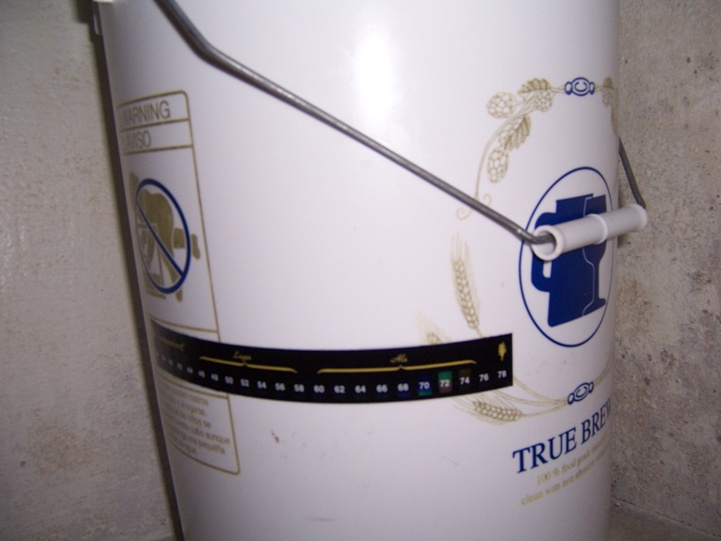
The honey wheat ale that I brewed on Sunday has been fermenting away in the coolest place in my house: my basement.  Although the air temperature down there is around 70 degrees, I have had a hard time keeping my fermentation temps down within the recommended range for the yeast (68-73F).

I put my bucket in a styrofoam box and filled it 1/3 of the way up with water.  I put ice packs in there to keep things cool.

Things must have been steamy in there since my thermometer strip kept registering around 78F.  After the first day, I was able to get it down to 76F and now it’s down to about 72F.

Some notes:

With a lower water to grain ratio (about 1.25 quarts per pound of grain) mash and these fairly high fermentation temperatures, I am wondering how this beer is going to taste.

Is it gonna be too sweet and estery?  Part of the reason for brewing this batch is to get a good understanding of honey malt.  This recipe is a showcase for it.

I just don’t like it when other factors like high fermentation temps, that I didn’t plan for, have a chance to alter the results.

I did pitch a good starter, and the yeast ferments clean…so I have that going for me.

Now that the fermentation is winding down, I am probably going to take the bucket out of the box and just let it mellow for the next week.

Here’s a couple of photos:

Swamp Cooler Light Temperature Strip

If you would like to follow along with this brew session, check out these links:

Honey Wheat Ale Recipe

Honey Wheat Ale Ingredients

Honey Wheat Ale Plans

Honey Water Solution

Honey Wheat Ale Bottling Day

Hallertauer Hops

Here is another entry in the noble hops series.

Hallertauer Hops is the name of a traditional variety that is grown in the Hallertau section of Bavaria…which is a state (Bundesland) of Germany. To be even more specific, the variety that is known as “Hallertauer Mittelfrüh” is the one that is considered noble.

Because Hallertauer Mittelfrüh is prone to fungal disease, the acreage for this specific variety is not large. More energy is spent growing varieties that produce larger yields. To get your hands on some genuine Hallertauer Mittelfrüh hops may be a bit of a challenge.

Better brewing through science has given us substitute varieties that are close to the noble hop. They have the Hallertauer name, and they are similar to Mittelfrüher…but they are not the exact same. Here’s a list:

  • Hallertauer Gold
  • Hallertauer Tradition
  • Hallertauer Magnum
  • Hallertauer Merkur
  • Hallertauer Taurus

Some other varieties that were bred as substitutes include:

This hop is the key flavoring and aroma hop for Sam Adams Boston Lager.

More Stats:

Origin: Germany (see above for more details)

Aroma/Flavor: Very Floral, earthy with a little spice

Alpha Acid: 3% to 5%

Typical Usage: Flavoring and Aroma

Beer Styles: German and American Lagers

Other Noble hops include:

Honey Wheat Ale Brew Day

Hey gang~

I was able to plan and execute a brew day today.  This time around, it was the honey wheat ale.  Here are my notes:

For the mash, I was a bit lower than my intended temperature of 152F.  I mashed at 150F.

Even with the help of rice hulls, I still got a stuck sparge.  I had to disturb the grain bed a few times around the bazooka tube to get the flow going again.

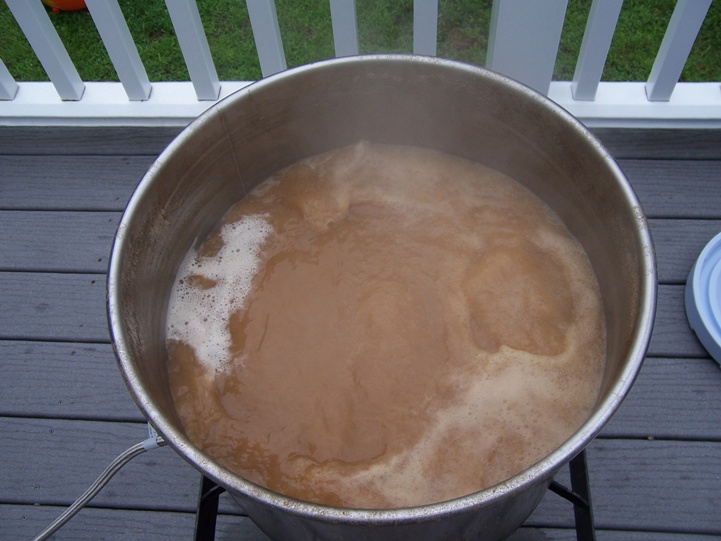
The boil went fine except for one boil over at the beginning.

I modified the recipe a bit.  I increased the base malts (2-row and wheat malt) to 5 lbs each.  I upped the honey malt to 1.5 lbs.

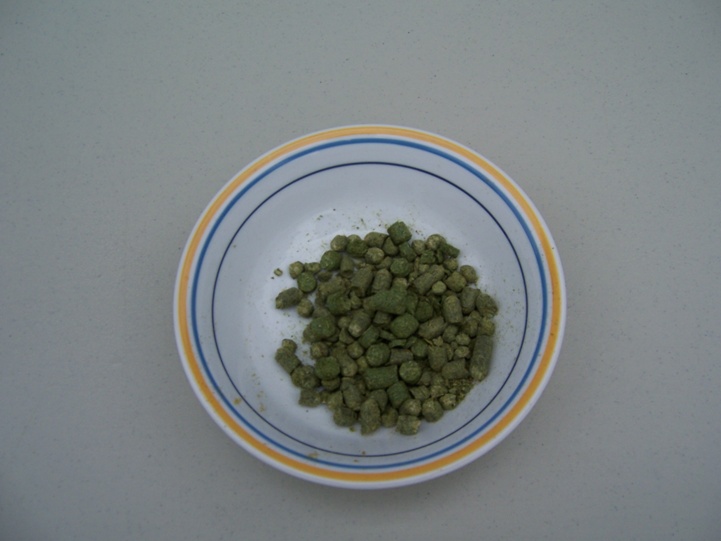
I  used Columbus hops for bittering (60 mins) and Fuggles/Styrian Goldings for flavor (30 mins).

Chilling the wort took a long time (1.5 hrs).  The air temperature was 80F and the tap water temperature was 64F.  Sheesh!

The best part of this brew day was my yeast starter.  I made a 1 liter starter on Thursday night.  By Sunday afternoon, it had attained high krausen.   I have been making smaller starters and I hadn’t seen this kind of yeast activity before.  It was great.

Starting gravity was 1.060, so it was good to have an active yeast starter available.

The beer is going to be more caramel colored than straw colored, but that is the nature of the honey malt.

A couple of photos:

Fuggle and Styrian Goldings hops Honey Wheat Ale Boil

I will post more information as this brew progresses.

Homebrewing Clone Recipes

For this month’s installment of the monthly blogging event known as Fermentation Friday, Rob from PFIFF! wants to know:

What beers have you attempted to duplicate in your own homes, or which ones have you always wanted to reproduce, but have been wary of attempting?

From digging in the archives, we do have a few clone recipes that we would like to share. One is an Allagash White Clone recipe.  We would appreciate any feedback on it as this beer is a favorite of ours and to replicate from home would be, well, clone-tastic.

The other one is a feeble attempt at a Spaten Optimator Clone recipe.  After finding some online information and asking the readers for some tips, I (John) put that extract recipe together.   I haven’t attempted it.  I am definitely wary of it.  With a little reassurance, I will brew it this winter.

Love to get comments on either of the recipes.  We are here to learn and do.  Learn and do.

Page 257 of 322

Powered by WordPress & Theme by Anders Norén