Brew Dudes

Homebrewing Blog and Resource

The hobby of homebrewing beer

Smoked Malt

I originally wrote this post back in November of 2007.  I was wondering about smoking malt and if anyone had done it.  Alas and alack, it didn’t seem that anyone had.

I am reviving this subject to add more information about this type of malt and to ask the question again.  Here’s the profile for smoked malt also known as Rauchmalz:

This type of malt was made historically by taking malted barley and drying out over open flame, rather than the sun’s rays.

The town of Bamburg in Germany is well known for making smoked beers, although they are now made all over the world.

Flavor: Smoky

Color: 2.5  to 5°L – Light in color…

Body: I don’t think it adds body to your beer…it’s all about the smoke!

Use: Certainly in Rauchbiers and other smoked beer varieties like a smoked Porter or brown ale. Although Scottish ales have a smoky quality to them, it is frowned upon stylistically to impart that smokiness through smoked malt.

Now for my question:

I saw a recipe for a smoked porter.  It called for smoked malt (Rauchmalz) or that you could smoke your entire grist to get the same effect.  The question is:  Have you ever smoked malt?

Leave a comment and we will get this discussion going.  I would like to know any techniques or tips to smoke my own malt.

Honey Wheat Ale Bottling Day

Well, Mike and I bottled up half of the honey wheat ale last night and racked the other half onto a gallon of honey water goodness (1.5 pounds of honey in one gallon of water heated at 170F for 30 minutes -cooled to fermentation temperatures).

These photos will tell a better story:

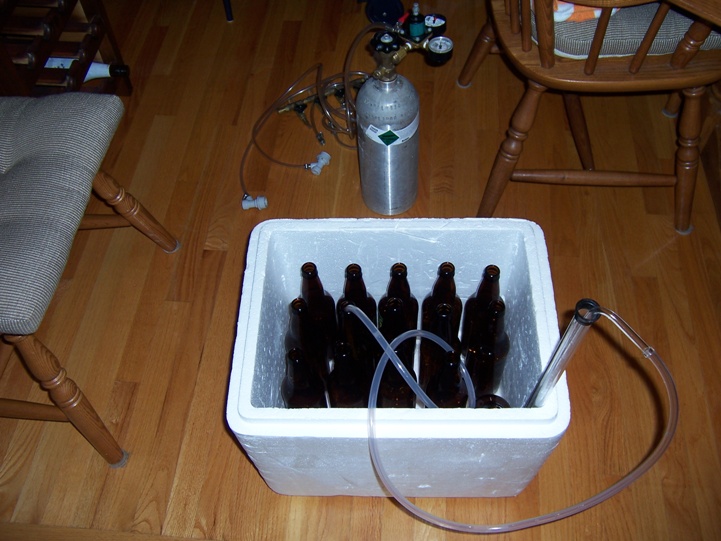
Bottles and siphon ready to go

Honey Wheat Bottling

Opening up the fermentation bucket

Cracking the fermentation bucket open

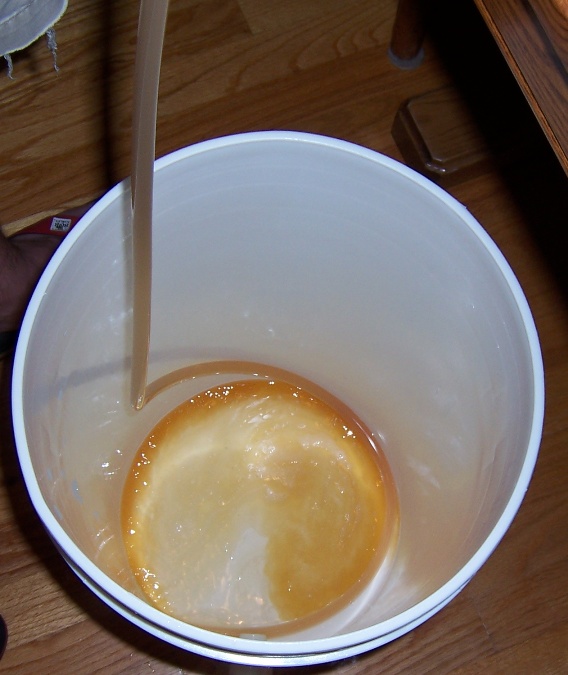
Racking to the bottling bucket

Racking To Bottling Bucket

Sanitized carboy ready for the second half

Sanitized Carboy

Finished bottles.

Full bottles

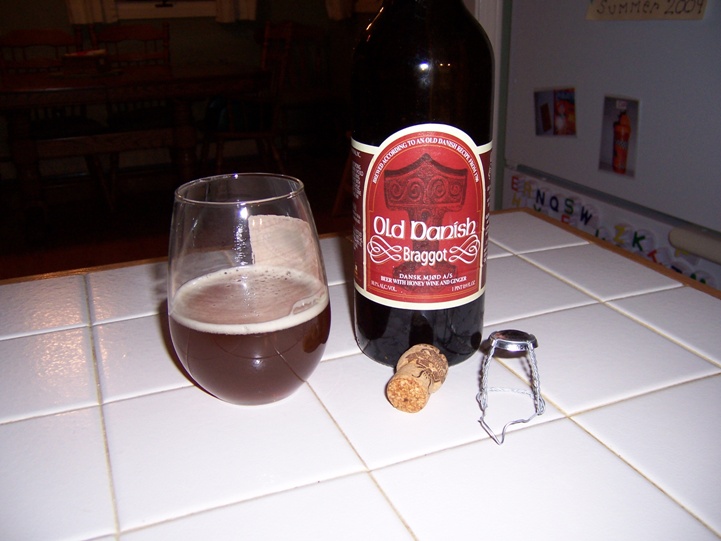
Reward!

Old Danish Braggot

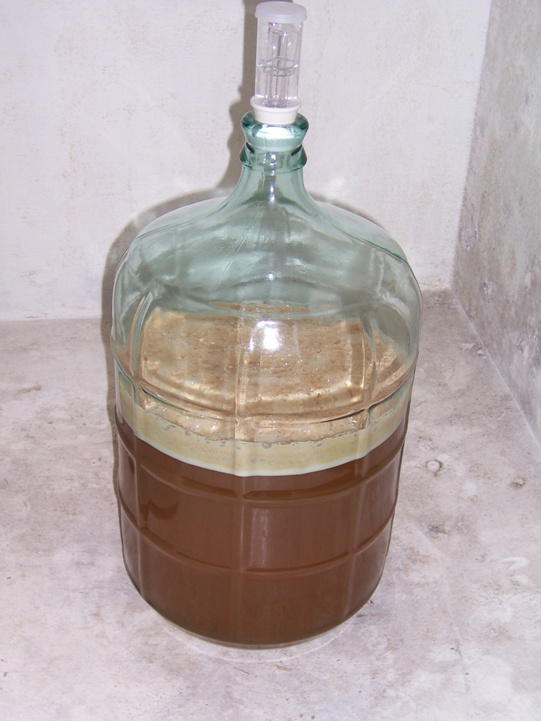
Krausen in the carboy (24 hours later)

Secondary Krausen

In two weeks, we’ll know how the original beer came out.  In 4 weeks (and many weeks after that) we’ll see how the experiment came out.

If you would like to follow along with this brew session, check out these links:

Honey Wheat Ale Recipe

Honey Wheat Ale Ingredients

Honey Wheat Ale Update

Honey Wheat Ale Plans

Honey Water Solution

Tettnang Hops

The last of the noble hops series is the Tettnang Hops profile.

The original hop variety comes from Tettnang which is a small town in the German state of Baden-Württemberg.

The first mention of hops growing in the Tettnang region is 1150 A.D….so a long time ago.  They were first grown for commercial purposes in 1844.

One source stated that they are so closely related to Saaz hops that they cannot be distinguished from each other.

There are hops that are grown in different places around the world that use the Tettnang name.   Hops with the label of Tettnang Tettnanger should be the authentic variety, but check to make sure.

Here’s the breakdown for Tettnang Hops:

Origin: Germany (more details above)

Aroma/Flavor: Rich, flowery, spicy

Alpha Acid: 3.5% to 5.0%

Typical Usage: All purpose – Bittering/Flavoring/Aroma

Beer Styles: German Wheat and American Lagers

Other Noble hops include:

Specific Gravity Of Honey Water Solution

I wanted to figure out what kind of honey/water solution I could make for this honey wheat ale experiment.  Through an email conversation, Mike gave me information on how to determine the specific gravity of a honey/water solution.

Seeing how the gravity of honey is going to vary a bit from season to season/batch to batch, I tried to figure out the best way to get to the SG value.  Here is what I figured out:

Best thing is you can apply this method to any new sugar or sugar solution you may want to determine the SG and PPG for (agave nectare, fruit extracts, maple syrups, etc…)
Specific gravity is a measure of points per pound per gallon.  Therefore, let’s put a pound of honey in one gallon and see what the hydrometer says….but that would be a waste of honey.

So we’ll calculate it down to a reasonable level.

I’ll assume that you need two cups of volume to get adequately fill a hydrometer tube.

One gallon is 16 cups.

So two cups is 1/8th of a gallon.

Conveniently enough, one pound is equal to 16 ounces by weight.

1/8 of 16 oz is 2 oz.
So if you put 2oz of honey into a total FINAL volume of 2 cups, you can read that with the hydrometer and get an SG and figure out the PPG as well [PPG=(SG-1)*1000].  Reason being, is that 2 oz of honey in 2 cups of water would be the same thing as 16 oz (1 pound) in 16 cups (1 gallon).

The way to do this is to put a measuring cup on your scale, tare it to zero, then squeeze in 2oz (BY WEIGHT) of honey.  Then add some tap water until you hit the 2 cup mark.  You can’t add two cups of water to the honey, because the honey has volume too and some water in it (albeit very little H2O).  Stir well until you think all the honey is dissolved. Then transfer to the hydro tube and read it.

Now the only thing left to do is figure out how many of points of honey you want to add and decide if that is a reasonable number of pounds or ounces of honey to achieve a desired effect in the final product from a flavor perspective.

Advanced Lesson:  If you are really clever, you could even use one ounce of honey in a final volume of two cups, then multiply the resultant PPG times 2 to account for the extra dilution.  Why would you do this?  Save on honey.  You can dilute it even more, but keep in mind that you may slip below the accuracy of the hydrometer at too low a gravity (reading 1.004 probably isn’t very accurate).  I would only dilute it once anyway because I think the gravity of 2oz in 2 cups is going to come it around 1.045-1.035.

I think I would like to shoot for a SG of 1.060 for the honey solution.  After we run this little experiment, we’ll know how much honey to add or subtract from a gallon of water.

Update: I just ran this experiment (mixing 2 cups of water with 2 oz by weight of honey) and got a hydrometer reading of 1.040!  Using Mike’s post (see below), I will need 1.5 lbs of honey to dissolve into 1 gallon of water to get a 1.060 SG.

If you would like to know more about this subject, read this post about working with Points Per Pound Per Gallon and Specific Gravity.

More Honey Wheat Ale Brew Log posts:

Honey Wheat Ale Recipe

Honey Wheat Ale Ingredients

Honey Wheat Ale Update

Honey Wheat Ale Plans

Honey Wheat Ale Bottling Day
Secondary Honey Wheat Ale Plans

Mike and I were talking this weekend about the honey wheat ale I have in the fermenter right now.

Our conversation was a continuation of thoughts I had about this brew.

I want to split this brew in half.  One half I am going to prime and bottle as usual.

The other half I want to rack to a glass fermenter on top of some kind of honey/water mixture.

What we need to work out is what the honey/water ratio is going to be.

The second half batch is an experiment in infusing honey flavor into a beer.

Once it’s racked, I will let it ferment/condition for another 2 weeks and bottle again.

It will interesting to compare the two halves once they are ready to drink.

We’ll let you know what the ration we come up with will be.

If you would like to follow along with this brew session, check out these links:

Honey Wheat Ale Recipe

Honey Wheat Ale Ingredients

Honey Wheat Ale Update

Honey Water Solution

Honey Wheat Ale Bottling Day

Page 256 of 322

Powered by WordPress & Theme by Anders Norén