Homebrew and the big game: Two good things that go well together.
Lots of brown porter to go around last night. It cooled off the hot wings fairly nicely.
What homebrews were you serving for the Superbowl?

Homebrew and the big game: Two good things that go well together.
Lots of brown porter to go around last night. It cooled off the hot wings fairly nicely.
What homebrews were you serving for the Superbowl?
Finishing off my 3 Cs hop profiles, I am having an uneasy time sitting down to write a post about Cascade hops. I mean, what else could I really add to the knowledge base already out there? Plus, in American craft beer brewing, it’s arguably the most popular variety in terms of use. In homebrewing circles, I have heard fellow brewers stating their boredom with Cascade.
So I chose to write a short passage about my “a-ha” moment with Cascade hops to do something different.
Picture it: Summer of 2000. My fiance’s parents were living in Portland, OR. The two of us had flown out from Boston to stay with them for a week. It was the first time spending “quality time” with my soon to be inlaws…so some pressure. I certainly had to try to put on a good performance. I was trying to avoid any plotline from the Meet The Parents film.
After a few days of me being grilled (figuratively), my fiance and I rented a car and drove up to Seattle. After checking in, we went down to a brewpub that was close by. We both ordered beers and I am not sure what I got, but I remember finishing off her IPA.
After every sip, there was this sensation of tangy fruit and citrus that I had only had hints of in say a Sierra Nevada. No, this was a Cascade hop bomb….and I had a small epiphany about the power of this hop and its affect on American beer brewing. Here I was in the Pacific Northwest, drinking a beer that defined the area for me but also was definably American…because this beer didn’t taste or smell like beers from other countries.
All good things happened after that pint. Her parents sorta dug me, we’ve been together ever since, and we have two healthy kids now. Frickin’ happy ever after.
Ok, not sure if the IPA had anything to do with it…but I still remember that moment like it was yesterday.
Here are the stats for Cascade hops:
Origin: USA. Bred in 1956, it is a cross between Fuggles with a Ruskie hop variety called Serebrianker(What kind of Cold War espionage was involved in procuring this hop?) It was bred at the USDA sanctioned hop breeding program at Oregon State University. Released to the public in 1972.
Aroma: You know by now. Citrusy, Flowery. Ubiquitous (just joking).
Alpha Acid: 4% to 7%
Typical Usage: Flavoring and Aroma. I have never bittered with it but it can be used that way too.
Beer Styles: American Beers
Read about the other BIG “C” hops:
As a continuation of our “Three Cs” hop profile series, this post is an examination of Columbus hops. As I dug into the history of this variety, I uncovered a saga of multiple identities and lawsuits.
Origin: It was bred in the USA by HopUnion. The year it was cultivated and made available to the public is hazy, but I am guessing early 1990s on the availability. Now, this variety also goes by the name of Tomahawk, which is a copyright of Yakima Chief, Inc. Based on the details of a lawsuit that was filed against Charles E. Zimmerman, it seems that Yakima Chief received this variety through Mr. Zimmerman and rebranded it.
Columbus hops are now patented and owned by a joint venture between Mr. Zimmerman and HopUnion. They mended their relationship and YC still gets to sell Tomahawk hops.
The Zeus hop variety is said to be similar if not identical to Columbus/Tomahawk. It is owned and branded by Hopsteiner.
Aroma: Earthy, spicy, pungent, with some citrus overtones. Not overwhelmingly citrus like Cascade. Strong herbal.
Alpha Acid: 14% to 16%
Typical Usage: Again, another dual purpose hop. Many sources saying it was a good candidate for a single hopped beer.
Beer Styles: American pales and IPA. Bittering for American stouts and lagers.
My opinion on Columbus hops is that they should be used as a bittering hop. They have a good American hop profile and a bit more pungent than other Pacific Northwest hops. Try bittering with Columbus in your next APA and try using a new flavor hop like Citra or Nelson Sauvin for the aroma hops. I think these would blend well with these newer flavor varieties but still give you the kick you are looking for in a bittering hop variety.
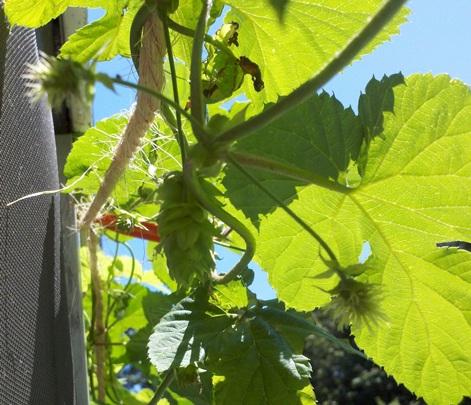
Other 3 “C” hops:
Over time, certain varieties of hops are grouped together. Noble hops are a group of hops that have been used in beer for a very long time and they are all grown in continental Europe. Another hop group, which is much newer, is the Three Cs. These are American hops that all have names that start with the letter “C” and have come to define ales brewed in this country. (Some sources now extend the group to more than just 3….but we’ll get to that.)
The first “C” hop to be examined is Centennial Hops.
Origin: USA. It was bred in 1974 (known as CFJ90) and released to the public in 1990. It is a cross between many different varieties including:
Aroma: Pungent. Citrus-Like. Floral but not as floral as Cascade. More bitter than Cascade though.
Alpha Acid: 9% to 12%
Typical Usage: Some sources stated bitterness; other sources stated aroma/finishing hop. I think Centennial is one of those great dual purpose hops.
Beer Styles: It is a defining hop variety in American pale ales and IPA styles. Some sources stated that they would work well in darker ales too.
Personally, from my experience, Centennial hops are definitely more bitter tasting than Cascade hops. They may be better for use early in the boil and in small quantities. If you put a large quantity in the middle of the boil, you’ll get plenty of bitterness from the hops and not as much fruity/floral taste and aroma as you would from Cascade. Experiment with this hop to see how it fits your tastes. In my experience, I was happier with beer where I used them early in the boil right at the sixty minute mark rather than in the middle – around the 30 minute mark.
Other 3 “C” hops:
Do we have any bulk grain purchasers in our readership?
What are people paying this new year for bulk grain?
I am thinking about stocking my brewing needs for the spring. My plan is to get a sack of American 2-row (Rahr or Breiss) and then to get a sack of English Pale (Maris Otter or Golden Promise). I may even get a sack of Weyermann’s Pilsner malt to knock out that Tripel I have tried a couple times last year.
Last I checked I could get a 50lb sack of pilsner malt locally for $68 bucks. Some of the online shops have way better deals on sacks but the shipping costs on a full sack generally wipes out the savings.
I do like ordering from MoreBeer.com in California. The weird thing about them is that you get free shipping when you order $60 or more. You can’t get a 50lb sack for free shipping but you can order 50lbs in 10 increments and get free shipping. Never understood that one…..
So there you have it. I was wondering what other people are paying across this great land for sacks of malt. I am sure we must have a couple readers that can simply get in the car and drive over to MoreBeer, NorthernBrewer, Midwest or Austin’s for good pricing. I am jealous of those readers.
Powered by WordPress & Theme by Anders Norén