Brew Dudes

Homebrewing Blog and Resource

The hobby of homebrewing beer

Tradition Hops

Tradition hops are a variety that was bred to be bigger, stronger version of Hallertau Mittelfruh – resistant to disease like yucky verticillium wilt and mildew and leaf eating incests.  The variety sometimes is labeled as Hallertauer Tradition, but not always because it is generally grown there and the geographical label is deemed unnecessary. 

I would put them in the same category as Mt. Hood, Liberty, Crystal, and Ultra.  These are all hop varieties that were bred in the US to produce high yields due to their ability to resist disease yet keeping all the noble hop flavor and aroma that we all know and love.

Since they are bred in Germany, Tradition hops are probably closer to the real thing.  Since there are so many different varieties that were bred to replace Hallertau, it brings up the question of how available true Hallertauer Hallertau hops are.  If I buy Hallertau pellets, are they the Gold variety or the Tradition version or what?  

Anyway, here are the stats for this particular version: 

Origin: Hull Hop Research Institute in Germany

Aroma: Refined, sweet floral, very much like Hallertau Mittelfruh.

Alpha Acid: 5 – 7%

Typical Usage: Aroma

Beer Styles: Pilsners, Other German Lagers, Wheat/Weizens
Racked The Oktoberfest

I finally racked my Oktoberfest to the secondary vessel.  I had it sitting at room temperature for two days to have the yeast clean up diacetyl if there was any.  Sunday would have marked four weeks in primary and it finished up nicely.

I checked the gravity as I was racking it.  My hydrometer read 1.012, which is in the style’s range.

The sample tasted pretty good – still rough around the edges but clean. 

Now it rests for its two month slumber.  Mellow out, my good lager.

Growing Hops In New England

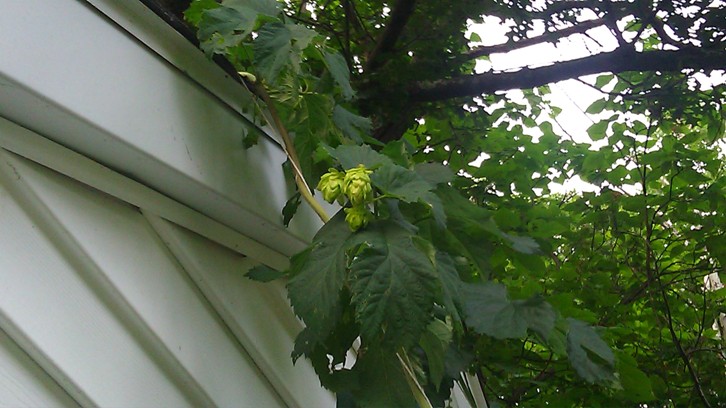
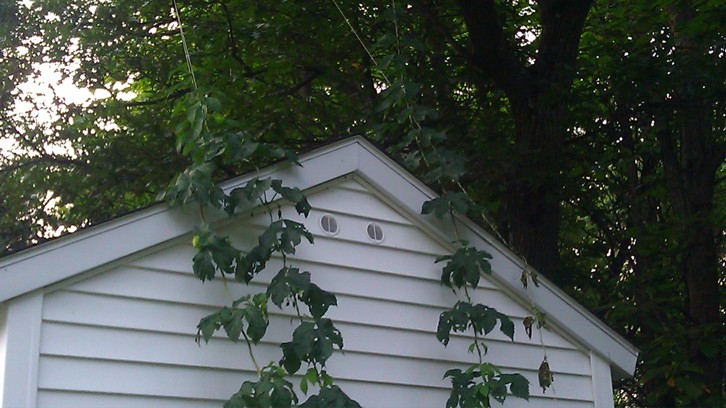
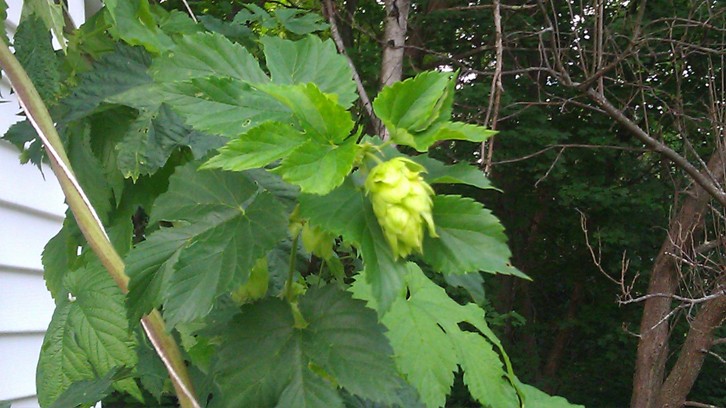
I can tell you that hop growing in New England isn’t as tough as I once thought or I once read.  Maybe hop varieties were susceptible to disease back in the day* but I have two different varieties growing strong this summer and they are starting to show some cones.

Granted, both varieties have been developed in the past 30 years and they were bred to be stronger plants.

So maybe that is the answer.  Maybe it was tough but if you get “newer” varieties, you can have great results.

I am not a good gardener, but I water my bines regularly.  I have put them in a place were they get at least 6 hours of sunshine a day.  I bought some good soil to plant them in a year ago and that’s it.  They are a hardy plant.  I think you would need to really do major damage to stop their growth.

Water, sun, and patience seems to be the formula for hop growing.  Here’s some photos: 

   Magnum Hop Cones Growing In Massachusetts  Magnum Hop Cones Growing In New England  Magnum Hop Bines Growing In New England

Harvest time will be here before you know it, but I hope it takes its time this year.

*Not sure if back in the day relates to colonial times or around the time homebrewing became legal.  In either case, a lot has changed since then but some conventional wisdom has not.

That’s not to say I have not had failures in growing hops. I had a Willamette hops plant that did not grow all that well in its first year and then did not sprout in its second year. Maybe it had something to do with the variety, but I didn’t really plant it in the right place. The area was pretty sandy and although I bought and put down some good soil, it may not have been enough. The basics cannot be ignored. You need to treat the plant right for it to flourish.

Oktoberfest Specific Gravity Reading

I checked the gravity of the Oktoberfest last Saturday and got a reading of 1.018.  I am targeting 1.015 so I am pretty close but not there just yet.

One of the most popular posts on our site discusses how long primary fermentation should be. With ales, two weeks is the guideline that we like to use.

With lagers, fermentation is much mellower.  I took that reading on Saturday and felt good that I was close, but I also felt like I was in no rush to get it to the target specific gravity.

Lagers need their time.  They need their temperatures to be low and their fermentations to be slow.

If you have it in your head that this beer is not going to be ready for months, then it makes for a relaxing fermentation schedule.

You know, I might not move it to a secondary vessel until mid-next week.  So there.

Golden Ale Recipe

With a Schwarzbier recipe posted, here’s the Golden Ale recipe that completes the Black & Gold set. I crafted this recipe from a blonde ale base with a little more color coming from the caramel malt. The SRM value is higher than the blonde ale range, but that’s the point.

Ingredients

10.25 lbs. American 2-row
0.75 lbs. 2-Row Caramel Malt 40L
0.3 oz. Magnum (Pellets, 14.5 %AA) boiled 60 min.
0.55 oz. Liberty (Pellets, 4 %AA) boiled 15 min.
Yeast: White Labs WLP001 California Ale

Predictions

Original Gravity: 1.049
Terminal Gravity: 1.011
Color: 8.81 °SRM
Bitterness: 22.8 IBU
Alcohol (%volume): 4.9%

Instructions

Mash for 60 minutes at 149°F. Sparge until you get a 6.5 gallon pre-boil volume. Boil for 60 minutes and ferment at 68°F for 2 weeks. Bottle or keg as usual. Carbonate to 2.5 volumes.

Page 207 of 322

Powered by WordPress & Theme by Anders Norén