
Brew Dudes

Homebrewing Blog and Resource

The hobby of homebrewing beer

Harvest Ale Brew Day

The first of two winter vacation brews is complete.  The harvest ale, which used homegrown hops, is currently fermenting away in the basement.

I made two 2 liter starters for the WLP002 and WLP008 vials.
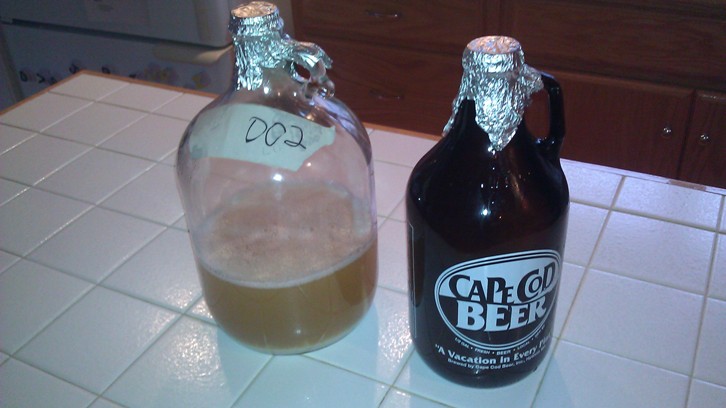
2 yeast starters

I labeled the 002 so I would remember the difference.  The 008 was used in the harvest ale.

My mash temp stayed pretty steady at about 154°F for the full hour.  I had some boiling water ready to add to it at the 30 minute mark, but I didn’t need it.
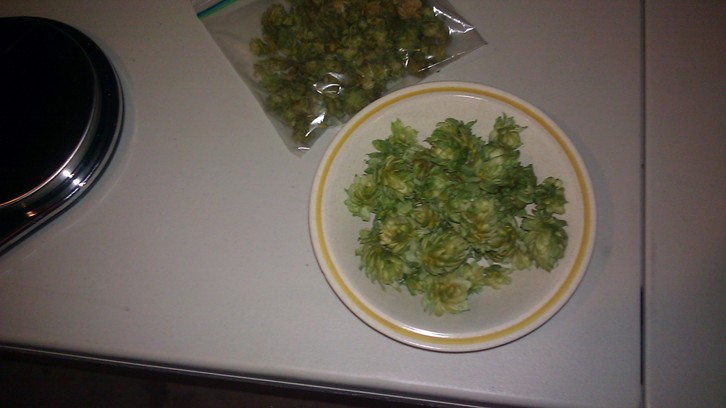
 

Dried Homegrown Hops

The boil went fine – seeing all the hop cones swimming around was great.  They do soak up some wort though.  Starting with a 6.5 gallon pre-boil volume worked.   I was able to get 5 gallons into the fermentor.
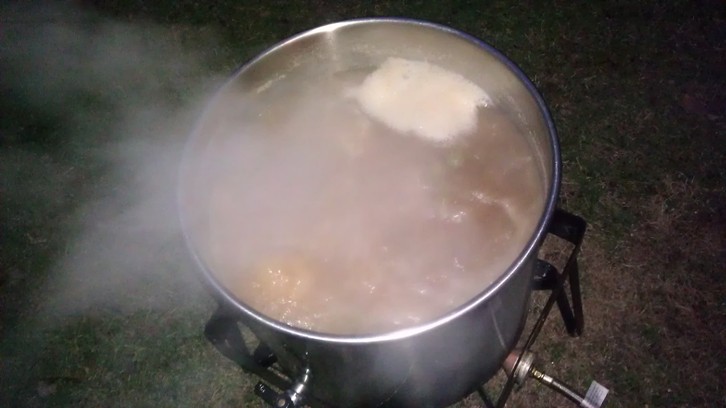
Boiling Home Brew Kettle

Knowing that the spigot on my kettle gets clogged pretty quickly with whole hops, I had my autosiphon cleaned, sanitized, and ready to go.

With the siphoning  out of the kettle, a long aeration session with the aquarium pump seemed necessary.  I let it aerate for a full hour before I pitch the yeast.

My final gravity was 1.055 which is where I wanted it to be.  The fermentation began quickly – in about 6 hours after pitching.

I read a bunch of negative comments about this yeast strain on boards.  It apparently can impart some tartness – If my hop choices work out – earthy, spicy rather than citrusy – then the tartness shouldn’t be a distraction.


Homebrewing Firsts

Although I have been brewing since 2005, there are many things that I just haven’t done yet within the hobby.  Next week, I plan to accomplish these new-to-me things:

  • Brew with Pale Chocolate malt
  • Brew with Lactose
  • Divide the sweet stout into 4 different secondary “tanks” for different flavor additives
  • Use the WLP008 yeast strain

I guess that’s why brewing is so interesting as a hobby.  It seems like there so much to it and it’s hard to get bored.  I wonder if people who have been brewing for over 30 years feel like there is still more to learn.

Learn and do.

Learn and do.

Next week, I will have some photos/recaps of the two brew sessions.  Hmmm, I should start making my yeast starters this weekend.


Golden Promise Malt

When I dug up information on Maris Otter malt, I found many references to Golden Promise malt.  There seems to be some debate about which is a better base malt for English style beers.

At Brew Dudes, we believe that experimentation is the only way to figure out the answer.  Now we don’t conduct as many experiments as we should but someday we’ll live up to the promise of our ambitions.

For now, let’s learn more about the history of Golden Promise malt.

Golden Promise is malted from a spring barley variety which was recommended for cultivation in Scotland in 1968.  It was grown by Miln Masters throughout the 1970s through the 1990s.  The malt was used largely by distilleries in Scotland but many UK brewers used it as base malt as well.

Unfortunately, the barley is very susceptible to disease so its large scale production is no longer.   Commercially, it does not have wide use but it is still available to homebrewers.

Flavor:  Sweet, clean flavor.  Some say it is superior to Maris Otter.

Color: 1.7- 2.0°L

Body: N/A

Use: Certainly can be used in Scottish ales.  It might be interesting to brew the same beer twice, one with Maris Otter – the other with Golden Promise and note the differences.


Maris Otter Malt

Maris Otter malt is highly praised for use as a base malt in all English style beers. I ordered some for the milk stout I am brewing later on in the month. After I clicked “submit” on my order, I decided to learn more about this base malt. Here is the Maris Otter malt profile.

The malt was developed by the good doctor, Dr. G. D. H. Bell at the Plant Breeding Institute and was introduced to the public in 1966. He crossed two different barley varieties, Proctor and Pioneer.

Although I couldn’t find where the name “Otter” came from, “Maris” was the name of the lane where the institute was located in Trumpington, Cambridgeshire, England.

It is a winter barley which means it is sown in autumn and germinate before winter. The malt was bred to brew cask conditioned ales. Many sources stated how forgiving this malt is in the brewing process. I am not sure what that means but it’s probably a commentary on how it handles mash temps or duration.

Flavor:  Brings a nutty flavor to your beers.  Other sources claimed a biscuity flavor.

Color: 3.5- 4.5°L

Body: N/A

Use:  Base malt for all English style beers.  It could be a good experiment to brew 2 beers – one using American 2-row and the other using Maris Otter and compare/contrast the tastes.

December Brewing Plans

Ok – enough making cider and mead. It’s time to get brewing beer again. Yay.

I am taking some time off of work in 2 weeks so I will hopefully have time to brew up a couple of beers before the end of the year.

First up is the Harvest Ale. I have all these homegrown hops in my freezer that are begging to be boiled in a kettle. Hops – they want what they want. The Harvest ale will be pretty straightforward and should be ready in January.

The second brew will be a sweet stout. With this one, I plan to have separate secondaries for different flavor combinations – chocolate, vanilla, cherry.

The plan is to ferment the full brew all at once and then rack it to separate secondary vessels and add particular flavorful ingredients to them like, uh, cacao nibs, vanilla beans, and cherry puree.

I gotta start ordering stuff this week so I have it in time for my staycation or brewcation. I gotta remember to buy a new autosiphon because I broke mine a few brews ago and more PBW.

Ok – end of ramble. Brew on.

Page 198 of 322

Powered by WordPress & Theme by Anders Norén