Brew Dudes

Homebrewing Blog and Resource

The hobby of homebrewing beer

Parti-gyle Brewing Experiment

I brewed up a batch of Winter Warmer/Holiday Ale at the end of December. I have noticed that my sparging efficiency has been going up lately, yet I haven’t adjusted my recipes to compensate for this (i.e. use less grain). So I end up dumping a small amount of wort out prior to the boil because I just don’t need the extra sugars to hit my target gravities.

I must have been in a frugal mood because I decided to try my first parti-gyle brew session; making a “small beer” out of the late runnings from the tun. Here is how I squeezed two beers from the same mash.

I collected 4 gallons of 1.083 wort from my first runnings (I batch sparge). More than enough sugar to end up with 5 gallons of 1.060 wort which is what I wanted in the recipe. I transfered the first runnings to my primary kettle to start the boil. I added my second infusion of sparge water to the tun and collected 4 more gallons of 1.037 wort. I did some quick calculations used some of the second runnings to get the proper volume in my primary kettle (which later became the Holiday Ale). I conducted a third sparge to collect another 2 gallons of wort and added it directly to the left over second runnings. I now had 5 gallons of 1.025 wort. Which I felt was a little low so I added one pound of DME to bump it to 1.034.

I added this second/third runnings wort to a second kettle. I have two burners, so I could boil these beers in parallel. I boiled off this “small beer” down to 4 gallons at 1.042 OG. For hops in this beer I wanted to just do a single addition. I tried something different and added 0.75oz of Nugget at 30 minutes. Hoping for enough utilization to get good bitterness while retaining enough flavor character due to the limited 30 minute boil. (In all I boiled the small beer for 30 minutes, made the hop addition and boiled for 30 more minutes.)

So this small beer is a mini version of the Holiday Beer (without the spices and bourbon). I suspect it might be a little like a Mild Ale, but I pitched American Ale yeast (Fermentis US-05) into both beers, so it won’t really be very English. If it tastes pretty good I suppose I could dry hop with some cascade and call it an American Pale.
I have to admit I am more excited about this little beer than I am about the Holiday Ale. I’ll add some tasting notes once its carbed up and ready to drink.
Willamette Hops

I wanted to pass along this anecdote. I was out to dinner with the family last night and my father in law ordered wine. It was from the Willamette Valley in Oregon.
My father in law, who lived in Oregon for a few years, was pronouncing the name of the valley and it took me by surprise. I told him there’s a hop variety with the name “Willamette” and I always pronounced it:

WILL-am-ette.

He told me there’s a saying in Oregon for people who mispronounced the name:

“It’s wuh-LAM-ette, DAMN it!”

(By the way, it’s Or-ruh-gin. Not Or-ruh-GONE. I learned that too from him.)

Now for the hop profile:

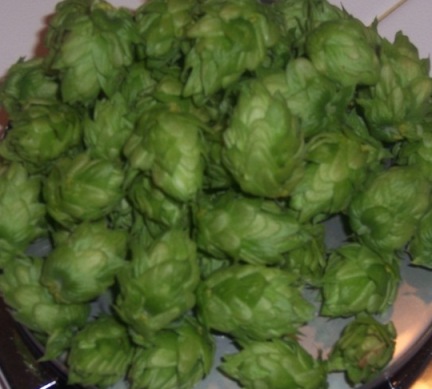
Willamette hops are a hybrid of the English Fuggle hop that were released by the USDA in 1976 and are named for the Willamette Valley where the majority of Oregon hops are grown.  The valley is on the 45th parallel which is closer to that 48th parallel that is noted as the place where hops grow the best because of the distinct seasons and the length of the day in the summer season.  They are a popular American flavor hop variety known for their earthy aroma and pleasant taste in a finished beer.

Origin: America (Specifically Oregon)

Aroma: Described by sources as mild having an herbal, woody, and earthy aroma.  Some fruit notes are also detected in some beers.

Alpha Acid: 4 – 6%

Typical Usage: For the most part, an aroma hop. Flavoring was also a primary use. Willamette hops can be used in ESBs, Pale Ale, Porters, Stouts. If there is a recipe that calls for Fuggles, try using Willamette instead for a more fruity aroma and flavor. Other possible hop substitutes include US Fuggle and Styrian Golding.

Willamette Hops

While you are here, check out other popular Brew Dudes hop profiles:
Ahtanum Hops
Simcoe Hops
Santiam Hops

Oatmeal Stout Brew Session

I brewed up another batch of Oatmeal Stout with a few minor tweaks (I’ll post the recipe separately). Got up at 5AM on Sunday morning to brew so I could hopefully finish before my wife went to work at 11.

Everything went fine with the batch except my chilling process.  I guess I didn’t clear my water supply hose well enough after the last session (Holiday Ale), because it had some frozen blockages in it.  So I had 7.5 gallons of 212F wort in my kettle on the burner and no way to hook up the immersion chiller (IC).

The only option I had was to transfer the beer directly into a sanitized bucket fermentor, add the IC to the bucket of wort, then carry the 5.5 gallons to the side of the house where I could get the IC to reach the faucet.  I chilled as usual without issue.

My concern is adding 212F wort to a plastic bucket may force some plastic like flavors to become evident in the beer.  I know from my extract days I used to put hot wort in a the bucket with out problem.  But in that case, I just added cold top off water right away.  Using a chiller, the wort cools down slower than that.

We’ll just have to wait and see.  Check back on this in a few weeks when I get the beer into a keg.

Happy New Year From Brew Dudes

The Brew Dudes brought in the new year with some homebrewed beer.  Here’s a video of the dudes enjoying and discussing Mike’s Extra Special Bitter:

If you want to learn more about the beer, follow these links:

ESB Recipe

ESB Tasting Notes

Happy New Year. Here’s to a happy 2008.

Blending Yeasts

I was reading Jamil Zainasheff’s Style Profile in the latest issue of BYO magazine.  His article is about the American Blonde Ale and he provides a recipe for his own Blondeinebier.  He lists three different yeasts that you could use to make this beer.   They were all clean fermenting American Ale yeasts, but it got me thinking.  What would the beer taste like if I used two vials of different yeast strains? 

I am not sure if there would be a detectable difference if I used two of the strains that he provides here.  The Wyeast 1056 and the White Labs WLP001 are pretty similar, but would if I threw in some other kind of ale yeast like one for an English style beer?   What if I used a lager and an ale yeast? 

Our category for “Experiments” has been empty for too long.  Next year will be about testing things out and posting the results here.   Let’s make a 10 gallon batch using the same grain bill, but divide the wort into smaller portions and pitch different yeasts. 

Good stuff.

Page 306 of 322

Powered by WordPress & Theme by Anders Norén