
Brew Dudes

Homebrewing Blog and Resource

The hobby of homebrewing beer

American Pale Ale – Tasting Notes

Here in the Northeast, specifically the Boston area, we have been locked in a heat wave. The past 4 days have been steamy with temps over 90 degrees. Sorry to those who experience hot weather on a regular basis…we just aren’t that used to this type of heat so soon in the year (it’s still technically spring!).

Thankfully, we have plenty of homebrewed beer around to refresh our dry palates and cool down a bit. These are my tasting notes of the American Pale Ale that I brewed up in March.

Appearance: Copper hued. I feel I hit the color of a pale ale spot on. The clarity needs a bit of work. I have some chill haze, so I am thinking I will need to use some finings to clear it up next time. Nice white creamy head with good lacing throughout.

Aroma: A present hop aroma but not strong. The glacier hops have a less citrusy aroma than the other American hops varieties, they are more earthy with some fruit notes. Some biscuit and malt tones too.

Taste: Pleasant hop bitterness. Not harsh at all or overwhelming but balanced with the malts which is now being dominated by the Victory malt profile with some hints of the Honey and Special B malts. Good carbonation with a clean finish.

Overall Impressions: I think this beer does the trick on a hot summer evening. I will append the competition notes to this post when I receive them. Maybe next time I will not use any Caramel malt (60L) and just rock the Honey and Special B.

Here is the American Pale Ale recipe.
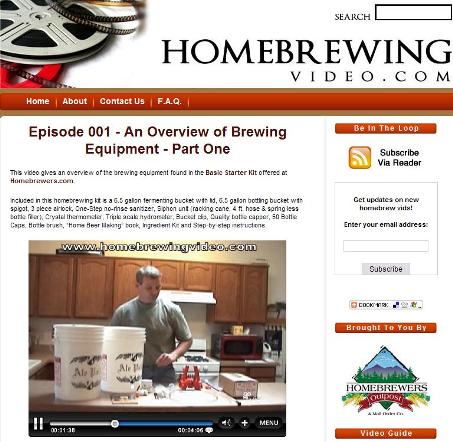
Home Brewing Video

Craig from Home Brewing Video wrote to us to check out his site.  As the title states, this is a site that has homebrewing videos. 

Homebrewing Video

They have videos on equipment and videos for beginners with plenty of “how to” clips.

Visit the site when you have a chance: http://www.homebrewingvideo.com

Time in Secondary

I see this question alot in the homebrew forums on-line: “How long should I leave my beer in secondary?”

This depends on a lot of things.  The reason most people do a secondary fermentation step is to get more stuff to settle out of the beer.  If you use a glass carboy for this (preferred) then you can visually check the beer on a week to week basis.  Once the level of junk at the bottom doesn’t change much, you are good to go.  I think in most applications 2-weeks should be plenty to help clarify a beer.

The second reason is to “bulk” age or maturate a beer.  Again this is very recipe dependent.  If the beer is not a high alcohol beer then it will mature faster than a big monster beer.

Lastly, you really will just need to experiment with maturation times.  You get a sense from the bottled product too if longer maturation is needed.  Then next time you brew maybe you can add some of that time to the secondary instead of waiting it out in the bottle.

The last thing to concern yourself with extended secondaries is yeast for bottling. If you plan to bottle condition (prime with sugar before bottling for natural carbonation) generally there will always be enough yeast to carbonate.  The longer the secondary, the longer it may take to carb.  With that said though, if I was to leave something in secondary for 6 months or more… that yeast may be worn out and too weak to really carbonate well, and adding an eighth to a quarter packet of rehydrated dry yeast to the bottling bucket may be necessary.

I hope that helps clear up some of that issue.
Check out these other threads of ours regarding secondary (and primary) fermentation:

Primary Fermentation

Skip the Secondary

Better Bottle Carboy 

Spices in Secondary 

Acidulated Malt

Acidulated Malt is an ingredient that I wanted to learn more about, so I did some research around the topic and consolidated it into this post.  Acidulated malt appears to be the brand name by the Weyermann Company.  Other maltsters may call this malt “acid malt.  It is produced using lactic acid.  From the Weyerman site, lactic acid is not added to the grain; it’s produced using the naturally occuring lactic bacteria on the malt.

Most sources explained that this malt can be used to change the pH of the mash or wort.  Having a more acidic pH assists in enzymes breaking down more starch for fermentation.  The Weyermann site gave a simple equation to lower the pH:

1% of the grain bill to reduce the pH by 0.1.

Flavor: Sour Character

Color: 1.7° – 1.8° lovibond

Use:  If your water is high in alkalinity, using this special malt may help you make better beer.  I think a good understanding of your water and getting very familiar with all grain brewing are prerequisites before using this malt for this purpose (you may not need to adjust the pH of your mash/wort).

Outside of adjusting your pH, you could use this malt in making the sour beer style of the Berliner Weisse.   The Weyermann site suggested using 8% of your grain bill of acidulated malt to produce the intended result.   I have the idea that this beer could be used to make other sour beer styles too.

American Beer Series

The 4th of July is around the corner and I am planning on banging out four great American Ales in honor of the Holiday. I’ll post the 4 recipes of the next 4 days but I’ll use this post as an anchor for the brewlog.

The beers I am going to crank out are as follows:

American Cream Ale
American Wheat
American IPA
American Brown Ale

The American IPA is already in bottles and that recipe can be found on this thread. If I can, I’ll crank out another batch of it and dry hop it this time too.

It’s a bit of a challenge with only a little over a month to go before the 4th but if I pitch healthy yeast with big enough starters, I should be able to skip the secondaries and go right to the bottle. (Or maybe its time to get a new kegerator???)

I think my best approach is to brew the Cream ale up, then use the cake from that beer as for the yeast pitches I need for the Brown and the Wheat. That should give me plenty of yeast to get a good fast ferment. For all these recipes I plan to use the Fermentis US-05 yeast. It’s currently my favorite American Ale yeast.

Cheers and stay connected to check the progress!

Page 293 of 322

Powered by WordPress & Theme by Anders Norén