Brew Dudes

Homebrewing Blog and Resource

The hobby of homebrewing beer

Homebrewing For The First Time

I remember when I first started homebrewing.  I should since it was only three years ago.  If I couldn’t remember, I would rack it up to too much homebrew…but that’s not the case.

On July 4th, 2005, I brewed up a True Brew Amber Ale.  I had purchased my equipment kit along with this recipe kit two weeks prior to the brew day.  I had brewed with the other brew dude Mike a few times in the past but this was the first time I brewed on my own.  I read the simple instructions that came with the recipe kit a few times to make sure I understood everything. 

I did my best cleaning and sanitizing all the equipment.  My uncle gave me a tip about brewing and suggested I buy spring water.  I got 5 gallons of the store brand spring water to make my amber ale.    

I got the largest pot that we had and poured a gallon and a half of the spring water into it.  I was able to stick the half empty (or is it half full) gallon with the 3 other unopened gallons in the fridge.  Getting the rest of the water to refrigerator temperature was key to get the wort cool enough for me to pitch my yeast.

From what I can recall, the boil went fine.  I think the kit came with two cans of malt extract, which I added at the start of the boil.   Once the hour was up, I put the pot in an ice bath in my kitchen sink.  I took the spring water out of the fridge and pour it all into the fermentation bucket.  Once that was done, I poured the wort into the bucket.  I took a look at the temperature strip on the side of the bucket and saw that I had cooled it down to 70 degrees.  It was like magic.

I fermented the brew for a week and then bottled it up.  I kept checking the bottles everyday to see what was happening inside of them.  I saw the yeast clumping up into big particles by day 7 and I really thought I messed things up.  I opened one up to taste how bad it was and was surprised to find it wasn’t undrinkable. 

A week later, I brought a 22 oz bomber to some event over at Brian Hammer’s apartment.  I opened it up and we all took a swig.  Mike gave me a “not bad” look.   Certainly wasn’t the best beer in the whole world (no real character) but a good start.  
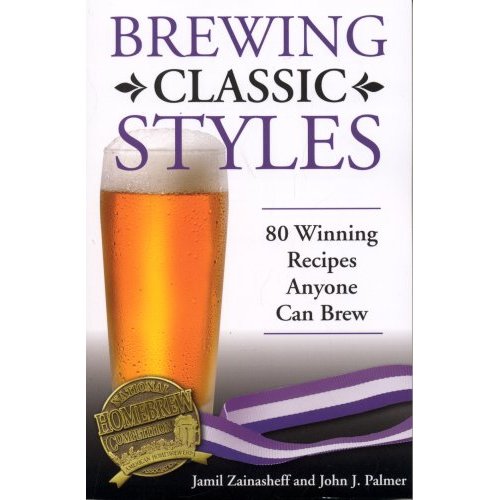
Brewing Classic Styles Book

Mike brought over a book he got recently for our homebrewing tasting session.  It’s written by Jamil Zainasheff and John Palmer and it’s entitled Brewing Classic Styles: 80 Winning Recipes Anyone Can Brew.  

When it comes to homebrewing recipes, Mike and I formulate our own based on our experience and on recipes we see (online and offline).  This book has definitive recipes coming from a guy who has won a ton of awards for his homebrews.

I thumbed through the book and I did see that it had recipes following an all grain procedure along with partial mash and extract only versions. 

I went on to Amazon and saw that some reviewers were disappointed by the book.  For the most part, I think they thought they were getting a book that had more science behind the recipes rather than just the recipes themselves. 

From what I saw, it looked like it was worth the purchase…as long as you understand that it’s just a bunch of recipes. 

Formulating your own recipes is fun, but it’s nice to have another point of reference for a springboard/sanity check.

brewing-classic-styles.jpg

Vanguard Hops

Vanguard hops are another variety that should be available in your local homebrew shop.  This profile is presented to provide more information for this “hop shortage” hop.

Origin: USA – Released in 1982

Aroma:  Slightly flowery, mild.  Similar to Hallertau Mittlefruh

Alpha Acid: 5.5 to 6%

Typical Usage: Aroma.  A gentle hop for subtle bitterness, aroma, and flavor.  Probably would be considered “noble”.

Beer Styles:  Use in not-so-overly-malty beers.   Light lagers, Pilsners, Kolsch, Wheat, and Munich Helles.

Homebrew Tasting

Yesterday, a few of us got together to do a BJCP-type tasting of the homebrews we have available. Those brews included:

  • Kolsch
  • American Pale Ale
  • American India Pale Ale
  • Oatmeal Stout
  • Maple Porter

We also had an apple cider that Mike got from a brewer he met on the Brewing KB. It was fermented with wild yeast, crystal clear, and light in color. It was phenomenal.

When we get together to drink beer, usually we are just being social and having a good time. This time, we read about the styles and focused on what we were tasting. We didn’t take notes, but I think we learned a lot because we took the time to really understand the flavors of each sample.

And we had a good time too.

Now, if we can get another bottle of that apple cider. 🙂

Choosing Yeast Strains For Brewing Beer

In this day and age, there are yeast strains available for every beer style. When you are formulating recipes, it’s good to get familiar with the types of yeast strains available and which ones have been developed for the style of beer you are looking to brew. Here are some links to keep handy when researching yeast strains:

BYO Magazine’s Yeast Strain Chart

White Labs Yeast Strains

Wyeast Laboratories Yeast Strains

To make a beer to style, it is essential to use a strain that suits the style. To experiment and try something different, use a strain that hasn’t been developed specifically for the style you are brewing….like a white beer with a lager strain…which is my latest potential experiment.

Remember, yeast are your friends…even if they look funny. Based on the way I eat, I swear I was a yeast cell in a former life.

Beer Yeast

Saccharomyces cerevisiae images provided by Peter Hollenhorst and Catherine Fox.

Page 294 of 322

Powered by WordPress & Theme by Anders Norén