Brew Dudes

Homebrewing Blog and Resource

The hobby of homebrewing beer

One Gallon Small Batch Brewing

I have had a lot of fun this year brewing at least one batch a month.  Surprisingly we have been drinking it all too….  Well, not just me, a couple well attended summer family BBQs and such has helped out with that quite a bit. I have brewed 12 batches this year already, and I still have 4 more months to go!  It will be a banner year. But I am not quite ready to recap my brew year yet.  I wanted to write down some thoughts on something else.

I have a small scale experiment planned, the one gallon batch.  Using small batch brewing as part of an effort to really hone a couple of my favorite recipes, I feel it’s important to be able to taste changes side by side.  The one gallon batch might be a great way to do this.  Whether it be splitting a larger wort and using different yeasts or dry hops; making a beer that is just as fresh as a different version is key to good comparators.

Here’s my plan: What I worry about most is yeast blow off and making a big mess, only because it’s a hassle.  I purchased a couple pounds of DME, some C60, some EKG and a pack of dry yeast (that I’ll measure and rehydrate for one gallon).  I also have some anti-foam that I used recently on a starter and it worked really well.  Some night soon I’ll attempt my first small batch brewing session in a spare one gallon glass jug I have been saving.  I’ll actually use less than one gallon to give me a headspace and help with krausen.

My hope is that if I can control the ferment enough to not make a total mess maybe I’ll be able to get 2-3 decent bottles of beer out of the batch.  I have multiple 1 gallon jugs and then I could do a dream experiment of making a big batch of English Brown Ale or Ordinary Bitter wort. Split it up and compare 6-8 English yeasts all side by side at the same time.  That would be EPIC.

Just some Friday ramblings.  Let me know what you think.  Or if you’ve tried this yourself, give me some pointers.  It’s all about making better beer and learning how to do it as we go.

BREW ON!
Bramling Cross Hops

Back to the Brew Dudes’ internal search queries I go to find hop varieties for which our readers are looking for information.  One variety that we haven’t done a profile on is Bramling Cross hops.

I have never seen these at my local homebrew shop but that doesn’t mean you can’t get them online.  They are an English hop variety developed by a Professor E.S. Salmon at Wye College in 1927.  As the name implies, they are a cross of the Bramling variety of Goldings hops and a Manitoban (that’s Canada, eh?) wild male. Professor Salmon also developed Brewer’s Gold hops, among other varieties, just so you know.  I am guessing they were looking to breed a hop that could replace Goldings – yield more cones, be resistant to more diseases.

Here are the specs:

Origin: UK

Aroma: Black Currants. Vanilla?  Earthy.

Alpha Acid: 5 to 7%

Typical Usage:  Dual Purpose, but I think it would be better as an aroma hop

Beer Styles: I am thinking dark English ales and Holiday ales. If you use it for pale ales, it may not have that traditional hop character that you or judges may be looking for. Give them a try.


Extra Special Bitter (ESB) Recipe

ESB Recipe #2 Modified slightly from the recipe below it (version #1)

Time to revisit the recipe that I haven’t done since 2007.

Batch Size 6.5gal
Boil Size 7.75gal
OG 1.052
IBUs 42 (Tinseth)
Color 14.6 SRM

12.5lb Maris Otter UK (3L)
0.75lb Crystal 40L
0.6lb Biscuit Malt (25L)
0.5lb Pale Chocolate Malt (200L)
1.0 oz Challenger Hops 7.5%AA 60min
1.0 oz EKG 5%AA 60min
1.0 oz EKG 5%AA 20min
1.0 oz EKG 5%AA 1min
WLP002 English Ale and WLP007 Dry English Ale

(Intend to split the batch 3 gal each and test two yeasts.)

Recipe 2007 Version #1

I was toying around with my new copy of BeerTools Pro (future review post coming) and starting thinking about Extra Special Bitter or ESB. I make a regular Ordinary Bitter and thought about kicking it all up a bit and trying something with a little more oompf. Here is what I came up with (exported directly from BeerToolsPro). I’ll let you know how it comes out in a future post. It’s fermenting nicely at 70F right now.

ESB

8-C Extra Special/Strong Bitter (English Pale Ale)

BeerTools Pro Color Graphic

Size: 6.5 gal
Efficiency: 62%
Attenuation: 75.0%
Calories: 187.24 per 12.0 fl oz

Original Gravity: 1.056 (1.048 – 1.060)
|==================#=============|

Terminal Gravity: 1.014 (1.010 – 1.016)
|==================#=============|

Color: 15.8 (6.0 – 18.0)
|=====================#==========|

Alcohol: 5.53% (4.6% – 6.2%)
|=================#==============|

Bitterness: 48.28 (30.0 – 50.0)
|======================#=========|

Ingredients:

14.5 lbs English 2-row Pale
1.0 lbs Crystal Malt 40°L
1.0 lbs Victory® Malt
3.0 oz Chocolate Malt
1.75 oz East Kent Goldings (5.0%) – added during boil, boiled 60 min
1.0 oz East Kent Goldings (5.0%) – added during boil, boiled 30 min
1.0 oz East Kent Goldings (5.0%) – added during boil, boiled 10 min
1.0 oz East Kent Goldings (5.0%) – added during boil, boiled 0 min
1.0 ea White Labs WLP005 British Ale

Schedule:

Ambient Air: 70.0 °F
Source Water: 60 °F
Elevation: 0.0 ft

00:05:00 Mash In – Liquor: 4.59 gal; Strike: 171.3 °F; Target: 154 °F
01:05:00 Conversion – Rest: 60 min; Final: 154.0 °F
01:10:00 Mash Out – Water: 2.04 gal; Temperature: 205 °F; Target: 168 °F
01:30:00 Batch Sparge – Sparge #1: 0.0 gal sparge @ 168.0 °F, 4.5 gal collected, 10 min; Sparge #2: 5.01 gal sparge @ 168.0 °F, 2.69 gal collected, 10 min; Total Runoff: 7.38 gal

Results generated by BeerTools Pro 1.0.28

New England Hard Cider Recipe

All right. This Fall will mark year 3 of making hard cider and I put together a New England Hard Cider recipe.

The first year we used the old press, the second year I used unpasteurized cider from a farm, and this year, well, I don’t know where I am going to source the apples/juice but it’s all about focusing on the fermentation.

From what I have read, it’s all about fermenting cold – think lager temps not ale temps.

So, the plan is to get cider apples from a place like Poverty Lane Orchards or get farm pressed cider from Cider Hill Farm. Then, use some additional ingredients, follow some additional processes, and be patient, patient, patient.

Brew Dudes New England Hard Cider

4 Gallons apple juice (from apples I press myself or get from a farm where they do the pressin’)
.5 pound extra light dry malt extract
.5 pound honey
.5 pound light brown sugar
.5 pound white sugar or whatever it takes to get to a starting gravity of 1.060
.5 teaspoon of yeast nutrient
2 packets of Nottingham Ale Yeast
.5 pound seedless raisins
4 ounces of American oak chips

Instructions

Dissolve malt extract, honey, and brown sugar into cider. Take gravity reading. Add white sugar until 1.060 gravity reading. Treat mixture with Campden tablets and let sit for 24-36 hours in airlocked carboy or heat mixture for 20 minutes at 150°F. After either method, cool to pitching temperature of 50°F.

Pitch nutrient and hydrated yeast. Aerate well.

Ferment at 52°F (maybe even colder – Nottingham can handle 54°F but we’ll see how it performs at 52°F first) for a month to 6 weeks or until primary fermentation is finished. Boil raisins in a cup of water for a minute or so. Add raisins to carboy for 2 weeks and maintain the fermentation temperatures.  Rack cider to secondary carboy on oak chips. Age for one month at fridge temps.

Treat with Campden tablets before bottling if backsweetening is preferred. Sweet to taste with white sugar. Bottle and condition for a couple of months.

Make this hard cider in October and it will be ready in March and beyond.

Final Results

If you like fortified cider that finishes with a medium body, some perceived sweetness from the malt along with smooth vanillin notes in the aftertaste, you’ll like this cider.  I bottled this cider and each 22 ounce bomber was something to be shared.  Its flavors were amplified and the ABV felt good on those last linger cold nights in March.  I enjoyed this New England Hard Cider – hope you do too.

Brew on!

Sinamar

That Vienna lager that I brewed a few weeks ago is looking a little light in color.

I read the style guidelines and it should be a copper color. Noting that one of the commercial available Vienna lagers is Negro Modelo, I wonder how well this beer will do in competition if it’s just a shade darker than “golden”.

Now, I am not absolutely sure what the color is going to look like in a pint glass. All 5 gallons are still in a carboy – but it looks lighter than what I would expect.

Ok – I have taken 5 sentences in this post to proclaim my concern. It’s about time I wrote about my insurance policy – my ace up my sleeve to get the color that I want.

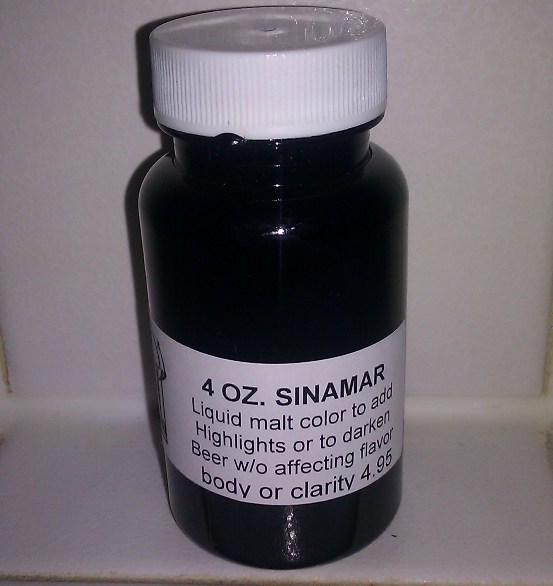
I purchases some Sinamar last week and it’s en route to my house. It’s an all natural liquid malt color which is made from Carafa malt by the Weyermann company.

It is in compliance with the German beer purity law Reinheitsgebot, if you care about that kind of stuff.

At bottling, I am going to draw a sample into a glass after racking the carboy to the bottling bucket and see what it looks like. Hopefully I will have a sunny day and walk the sample outside to evaluate the color. If I feel like it needs to be darker, I will add a small amount (.5 fluid ounce or 1 tablespoon) to the bottling bucket, mix it around gently using a sanitized spoon, and take another sample.

I’ll continue this sample evaluation/Sinamar addition until the color is what I want it to be. It’s probably fine but I have a backup plan.


Behold – SINAMAR!


Sinamar

Page 183 of 322

Powered by WordPress & Theme by Anders Norén