
Brew Dudes

Homebrewing Blog and Resource

The hobby of homebrewing beer

What is Mash Efficiency?

After John got his new mill he began to wonder what other advantages having a mill would deliver, aside from crushing grain.  That leads us to a discussion on mash efficiency, what it is and roughly how you calculate it.

Every grain has a theoretical maximum amount of sugar (post a saccharin conversion from starch) that it will yield.  Brewing chemists and maltsters have devised a test that involves completely crushing malt into powder and seeing how much sugar it will yield.  For the homebrewer, the expectation of that level of yield is unrealistic. Primarily because we don’t crush our grain into super fine powder and get 100% access to the starch and enzymes.  We need to retain some structure to the malt in order to create a filtering mash bed in the form of good husk material.  A good mill attempts to deliver great starch access while preserving malt kernel structures that assist in lautering.

There in we have the loss of 100% sugar recovery from the “ideal” lab standard.  The difference between what the lab gets and what you get from your mash tun post lauter is often converted to a ratio, and expressed as a percent.  On average 70-75% is a very good mash efficiency.  More efficiency in your system means you need less grain to get the same OG from a recipe written with a lower efficiency.  Often magazine articles are written with a lower efficiency than what we call ‘average’.  I am not sure why this is, perhaps its historical.

Why do you want to care about efficiency? Well primarily its necessary for us as brewers to communicate recipes back and forth.  If your process yields a much higher efficiency than mine your recipe will be out of balance.  This becomes big issue when a recipe must be balanced against the IBUs.  Think of producing an IPA at 1.065OG with 65IBUs.  That balance between bitterness and gravity will be way off if you end up only getting an OG of 1.045 and still use enough hops for 65 IBUs.

There are some cost savings as well.  Large commercial breweries strive for very high efficiency because when hundreds of pounds of grain are being mashed every little bit helps the bottom line of the batch.  10% of that size a batch can mean a lot of cost savings.  On the homebrew scale if you were to jump from 70% efficiency to 80% efficiency its like saving 10% in grain.

Lastly, efficiency gets a lot of attention sometimes in this male dominated hobby.   Bettering each other in efficiency is like a pissing match of maleness sometimes.  The important thing is that increase efficiencies often come at a price.  Some brewers report a loss in overall richness or fullness from a malt bill when the efficiency gets close to 85% or more.  This isn’t well understood quantitatively but from a qualitative side is seems right to me.  Higher efficiency often means more water in the sparge, which means more tannin and other flavors.  An interesting way to see what I mean is to do a batch sparge.  Save a little first runnings and take the gravity.  Then measure the gravity of your second runnings.  Dilute your first runnings down to match the gravity of the second and do a side by side taste test.  The first runnings do taste more maltier despite being at the same gravity.  There is something about the desirable malt flavors that we like that seem to concentrate in those early runnings.  The same holds ups with fly sparging.

We don’t talk about how to adjust your efficiency here perhaps that best for a second post.  But if you want help on how to work with gravity points and scaling the sugars in your recipes check out this old post of ours on working with malt PPG.
Buy a PicoBrew Zymatic and Sell Your Homebrewing Soul?

One of the topics I wanted to write about is the PicoBrew Zymatic.  If you haven’t heard about this system, the guys at PicoBrew ran a successful kickstarter campaign to help build a table top device that brews beer with the click of a few buttons.

Part of the story behind the invention was that the hobby of homebrewing is challenging, especially when attempting to the same recipe more than once and expecting the same results (very similar to the folk definition of insanity).  With so many variables in play when homebrewing, many due to basic equipment that makes it difficult to exactly replicate conditions from batch to batch, the solution was to build a system where the variables could be controlled.

The other issue their invention was trying to solve is the time it takes to brew beer at home.  They point out that there is no art or fun in cleaning up a kettle.  A machine that can brew beer in a self contained unit with a wash cycle will eliminate the need to carve out the 30 minutes you need to clean up after yourself.

For people who may not have a lot of space to house homebrewing equipment, this set up takes up less square footage than even a simple kit.  Again, another positive that this invention has going for it.

These are all great issues that, if solved, would make homebrewing more enjoyable than it is following a typical procedure.  The typical brewing at home techniques having progress much since the hobby was legalized in the late 1970s.  We should celebrate the innovations that this device is bringing to homebrewers.

The big drawback is the price.  For us here in the States, it is a $1,700 investment.  Over the 9 years I  have been brewing, I don’t think I have sunk that much money into the hobby.  If time, control, and space are things you want to fix with a one time purchase, there is value to buying the PicoBrew Zymatic.

Of course, the philosophical side of me wonders if the soul of homebrewing is lost with the ability to push a button and make beer. I like the challenge of trying to control conditions with an imperfect system.  I don’t mind scrubbing my equipment when I am done brewing.  Time brewing is time away from the other stuff in my life, which is a good thing.  🙂

I am not a purist but certainly someone who has it in his thick head that something worthwhile is something worth working hard to accomplish.  Now if the price came down by 50% and it produced better beer than what I brew with my junk system and manual labor, then there would be no other way to brew but with the Zymatic.

What do you think? 

Is there anything lost with this technology, especially with so many gains?

Comment below, please.

Tasting Results for Top Mashing

You may recall a few weeks back my Dry Stout brew session video.

This week, we get around to tasting this beer.

I admit that this one didn’t ferment out as dry as it should.  Not exactly sure why that is.  If I had to guess I’d say that its because I had a bit of a tough time controlling and holding my mash temp where I wanted it (152-154F). Brewing in the cold temps and using a direct fired mash tun sometimes becomes a challenge.  Adding too much or too little heat leads to drastic swings when the ambient temps are pretty low.  However, this brew doesn’t really taste as sweet as a 1.018 finish gravity would suggest.  That leads me to believe that the high finish is more of a mash profile thing than an incomplete fermentation, but I digress… How does it taste?

The best part of this beer was its smoothness. It’s tough to really qualify the results without a side by side of a non-top mashed copy but I have brewed many different stouts and the roast character here just tastes so smooth. Despite crushing the pound of roasted barley into a fine powder there are no notes of ash, no astringent bitterness, and no burnt malt character.

John described the roast character as more dark chocolate as anything else. The roast character plays pretty nicely into the biscuity and nuttiness of the Maris Otter base malt. The flaked barley is hard to discern with the stated mash issues. However, the body is pretty nice to go with a little stout like this.

In the end, I really think top mashing warrants more experimentation. I have a couple more stouts in the near future and I will definitely be doing more top mashing. I also plan to do some pH checking of the mash to see how top mashing really effects that aspect of the process.

In the meantime, I’ll be out in the garage drinking dry stout and watching winter finally start to break here in Massachusetts.

BREW ON!

Another Mazer Cup and Other Assorted Notes

Hey there everybody,

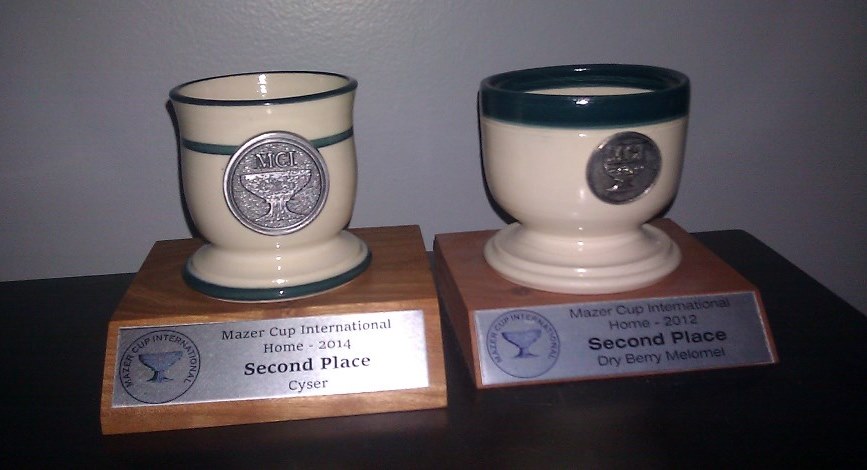
I found out last week that I won second place for a cyser I entered in the Mazer Cup mead competition and today the little cup was sent to my door. It has taken its place next to the other one I won a couple of years ago.

Mazer Cups

It’s nice to win these awards but without a score sheet, I feel the achievement is incomplete. I seem to remember getting notes on the raspberry mead that I submitted in 2012 so I am hoping that it will be delivered separate for the cyser.

Interestingly enough, this cyser was a one gallon side experiment – just a pound of honey that I got from the Merrimack Valley Apiaries and enough pressed apple juice from the kind folks at Cider Hill Farm to fill up the gallon jug. It’s a good thing champagne yeast does not foam up or I would have had a big mess on my hands. We’ll see what the notes say but a good showing in a national competition.

Other Notes:

Lo and behold – with almost a month’s worth of time gone by since bottling, the 2013 cider is finally starting to carbonate. I had a bottle this past weekend and it was almost to what one would describe as sparkling. This turn of events was welcome since I did not want to either get used to another batch of still cider or have to inoculate some bottles with yeast later on. I tweeted out my troubles last week and the feedback I received was grim. Well, if the yeast keep on fermenting, then we will have some very bubbly cider soon and a proper tasting session as well.

The mixed berry mead has been sitting on oak for almost a month and it’s time to rack it off. The goal now is to gain as much clarity as I can by racking it a few times to different carboys as the hazy stuff settles to the bottom of each of them. I had good results following this process with the other melomel. It should work for this one.

The dunkelweizen is finished fermenting and it will be bottled once I get my act together. The goal of keeping the fermentation temperature at 62°F was met for the most part. The basement was my friend over the past two weeks. It helped keep things in check. That beer should be ready to drink before the end of April for sure.

Lastly, the next brew session will be the first foray into sour beer making. Wish me luck.

Vic Secret Hops Profile

New hops are always fun to write about and this variety is as new as they get. Since I am on an AU kick, here’s another variety from that country.

Vic Secret hops, which had a name change when a certain chain of women’s intimate apparel told them they couldn’t use the formal name anymore, were made available to commercial production last year.

Clearly named for the state of Victoria and not the store, the variety was developed in 2000 with the same parents as Topaz hops. They have been used in some brews as experimental or showcase beers with local breweries in coordination with Hops Products Australia for a few years now.

Since they are new, they may not be in your local home brew shop here in the States, but be on the look out for them since the fruity hop revolution is underway.  Read below to learn more about the details of this hop.

Origin: Australia

Aroma/Flavor:  Pineapple, pine, passionfruit. The flavors are lighter than the ones you will find in Galaxy hops.

Alpha Acid: 14 – 17%

Typical Usage: This variety is definitely a flavor hop. The notable fruit flavors really come out in the finished beer when Vic Secret are added as a whirlpool addition or when dry hopping.

Beer Styles: Any hoppy beer style you can think of.

When it gets down to it, these fruity varieties inspire me to do a few things. The first thing is to not waste their delicate flavors by putting them in early in the boil. The second thing is to come up with a game plan to use hops with flavor profiles that complement each other. Does pineapple go with apricot? I don’t know. Maybe a better plan is to find hops that fit in the same flavor quadrant and max it out with unique but similar hops. Lastly, getting the dry hopping practice down is imperative. I cannot say I have a ton of experience doing it but maybe that is something I can work on this summer.

If you’d like to read more about this variety, check out Beer Maverick’s Vic Secret hops post where common pairings of other hops are discussed.

Page 140 of 322

Powered by WordPress & Theme by Anders Norén