Brew Dudes

Homebrewing Blog and Resource

The hobby of homebrewing beer

Summertime Update

Sometimes our posts don’t have a singular theme…so here’s a summertime update, laid back and easy.

Hope everybody had a good Fourth of July weekend and good beer was all around you. 

I’m thinking of getting another brew session going.  Not sure what I will brew at this time.  Probably something that will be ready to drink before the end of the summer.

Not sure who won the Sam Adams Longshot competition (it wasn’t me), but here are the styles that are the finalists:

  • Mild
  • Espresso Stout
  • Pilsner
  • Bock
  • When I get my judgement sheet, I will share it on the blog.

    More posts to come.   Thanks for reading. 

    Swamp Cooler MAGIC!

    After brewing up 12 gallons of American Wheat base beer last Friday night, I transferred it into three different fermentors and added my yeast.  Since I have been without a brewing fridge now for several months I was contemplating how I would keep these beers reasonable cool while they fermented.  I have used the “swamp cooler” method in the past but I was skeptical with the hot days we have been having and the fact that I was going to let the beers ferment in my non-insulated garage.

    Pleasantly surprised, I checked the temp of my swamp coolers last night and they were at 65F!!!  I estimate that the beer should be holding at 70-72F.  Still a little warmer than I normally ferment at, but its definitely not too hot.

    The beers are bubbling away nicely.  So all I have left to do now is rotate in and out the occasional frozen water bottle every 12 hours to be sure the temp doesn’t get away from me and I think these beers should ferment out just fine.

    I’ll try and snap a couple pics tonight and update the post, but here is the basic premise of the swamp cooler:
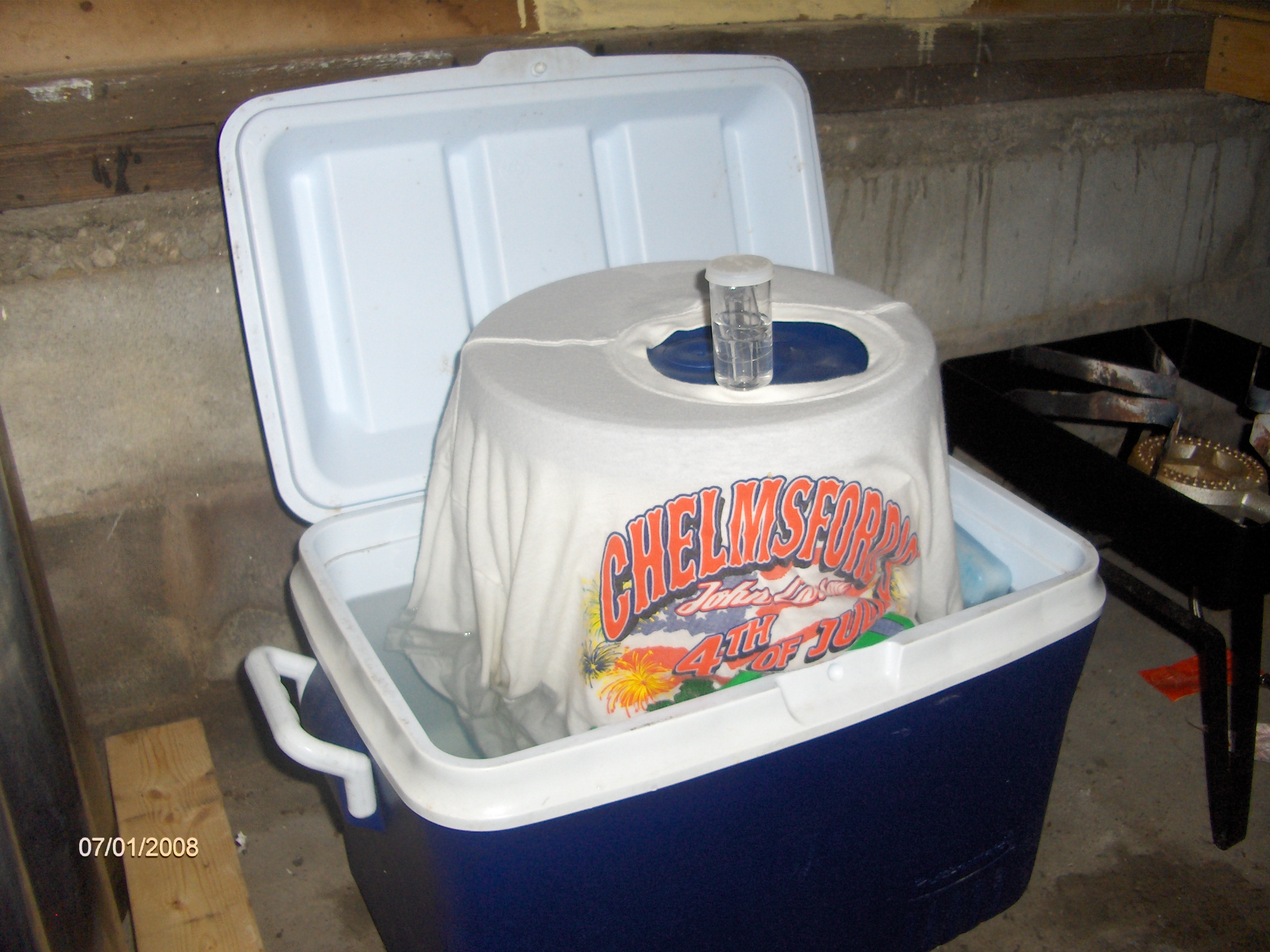
    I placed my bucket (or glass) fermenter into a cooler large enough to fit the bucket.  I then fill the cooler with normal tap water.  My tap water was about 65F to start with.  Next, I draped an old T-shirt over the fermenter and let the sides of it hang into the water.  Lastly, I added a floating thermometer to each water reservoir and I jammed in some “Blue Ice” cooler packs and or frozen water bottles.
    The wet cotton T-shirt helps to pull heat away from the fermenter, much like sweating does on a person’s skin.  I like to rotate in the frozen bottles to help keep the water in the cooler from becoming to warm.  If you want your cooler to operate colder, you need to rotate the frozen bottles more frequently.  You can also increase the wicking rate by using a fan blowing across the wet T-shirts.  Currently, by changing the frozen water bottles every twelve hours I seem to maintain my 65F temp pretty well.
    As fermentation slows, the beer won’t be generating its own heat as much, and I will be able to get the beer to cool off to 65F.
    You can use any normal bin or tub rather than a cooler to hold the water.  But I like the cooler because it helps insulate the water a bit from the surrounding rising temp of the garage and the garage floor.

    So don’t stop brewing in the summer.  Give the swamp cooler a try.  If I can maintain about 65F in a hot garage, a cool basement or closet should work even better.  Good luck.

    Edit 7/2/08

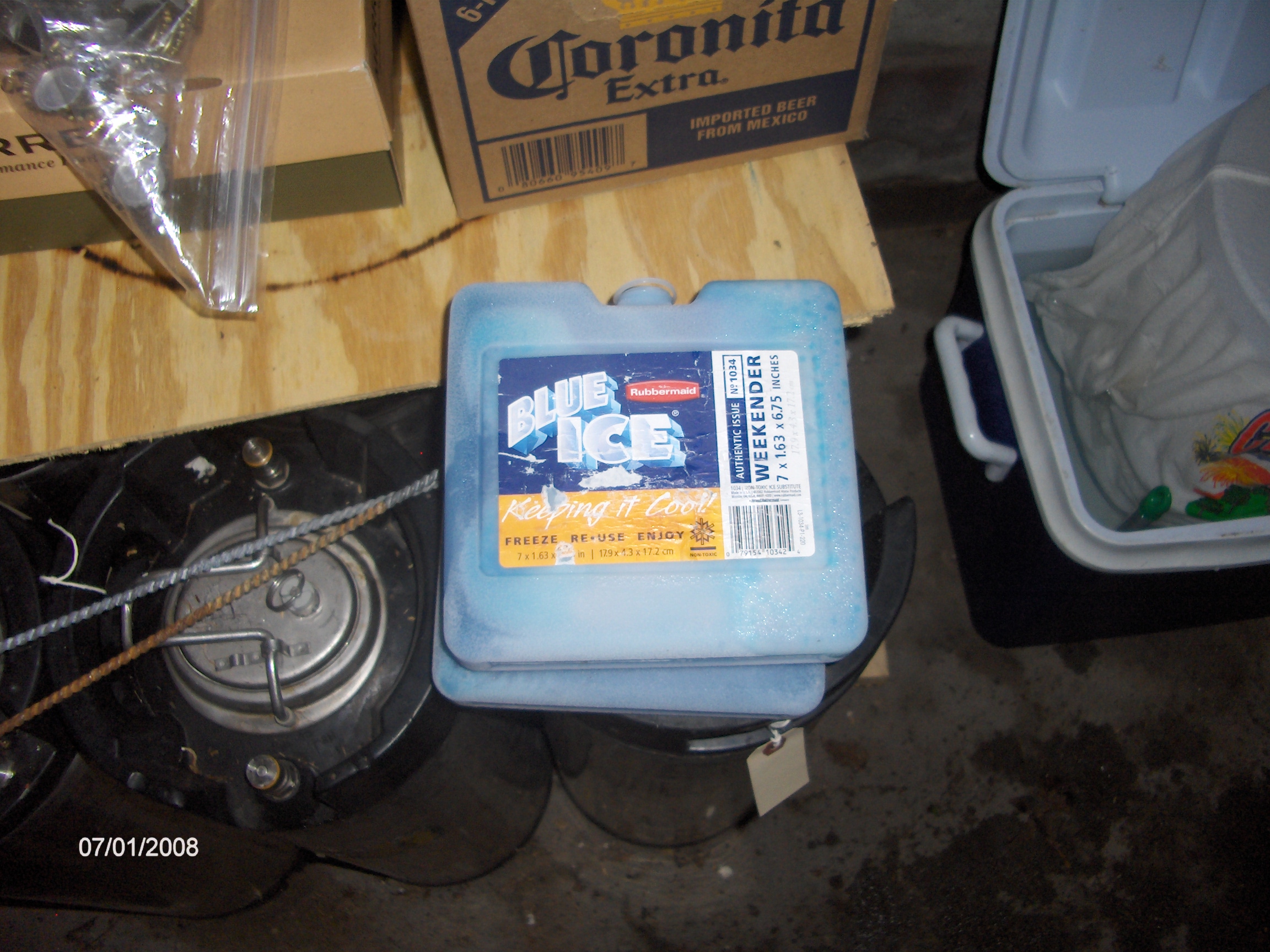
    Here are the pics of the swamp coolers in action.  I also took a picture of the “”blue ice” pack so you know what I am talking about.  After checking the temp last night I was still at about 65F.  I rotated in some more packs last night, then again this morning.  I double up on the packs in the morning because I expect the days to be warmer than the evenings.
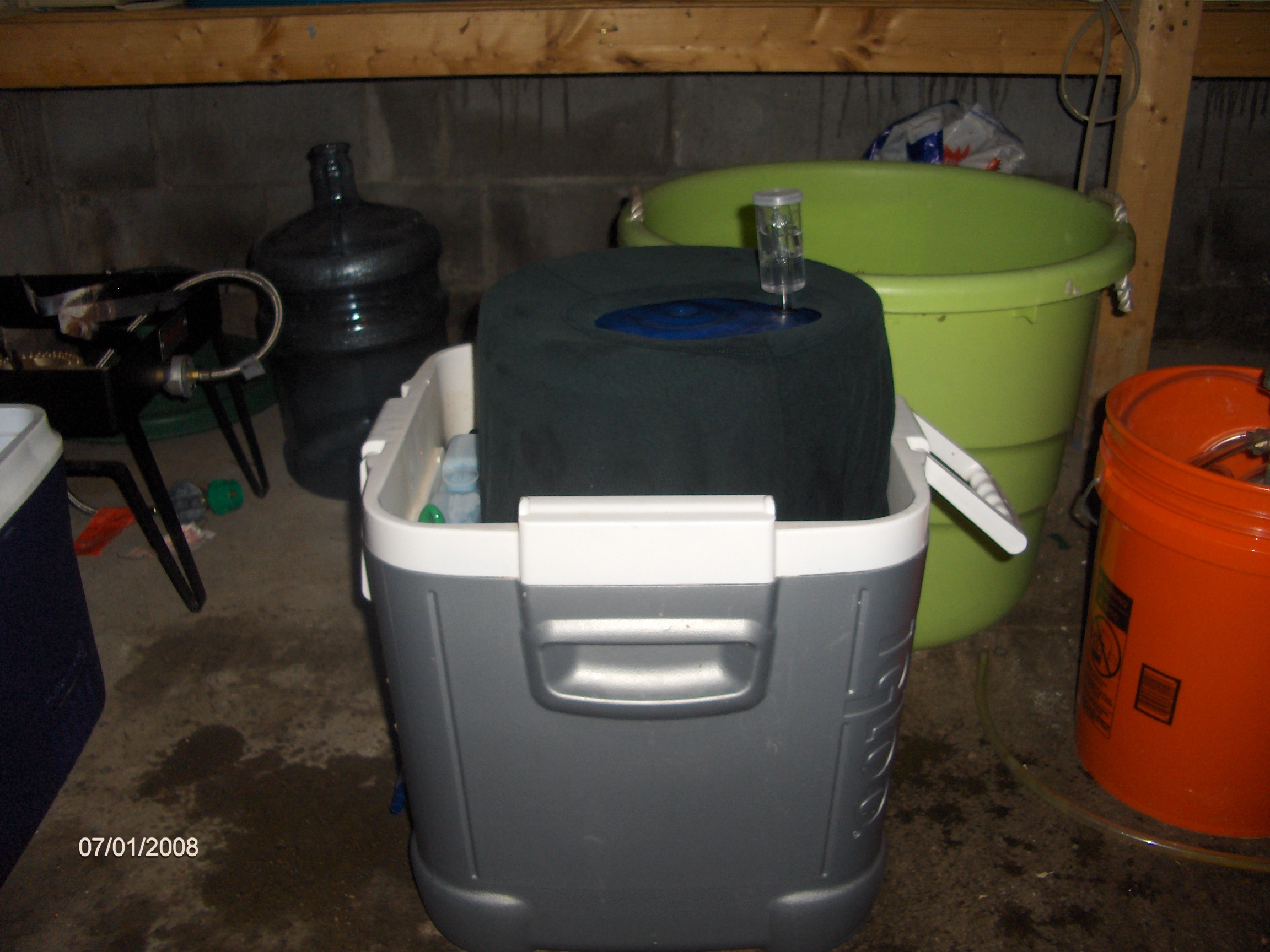
    Cooler1   Cooler2  Blue Ice Pack

    Mt. Hood Hops

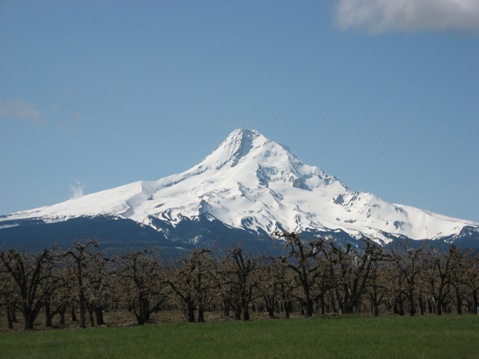
    Mt. Hood hops are profiled in this post.  I know Mt. Hood from my visit to Portland, OR.   The snow capped summit seemed to follow me everywhere while I was there.  I hope this variety is as majestic as its namesake.

    Origin: USA.  From my investigation into several hop varieties, it appears that many were developed to grow well in the Pacific Northwest.  Mt. Hood is no exception.  It was derived in 1983 from Hallertau Mittelfrüh to produce high yields.  It was released for our use in March of 1989.

    Aroma:  Spicy.  Mild.  Some sources said “Pungent”.

    Alpha Acid: Between 3.5 to 4.5% although some sources had a higher range of 5 – 8%

    Typical Usage: Aroma

    Beer Styles: This hop variety would work well in lagers with its clean bittering.  Maybe a nice American Wheat.

    Could this hop taste as good as this picture looks?

    Mt. Hood

    Fruit Beer Plan – Splitting Batches

    I was thinking of making up some “fruited” wheats in the next go around of the mash tun.

    I love trying to maximize my return in the brewhouse for the amount of work I put in, also while learning something in the process of each style I brew.  To that end, I think I am going to brew up a large batch of wheat style beer and split it into several fermenters for fruit additions in secondary.  Something along the line of an American Wheat (50/50 barley/wheat) with a simple hopping schedule.  This time though I think I want to use traditional American ale yeast like WLP001 or US-05.  I’ve never brewed a wheat beer without the contributing flavors of wheat yeasts, so now is the time to learn what wheat tastes like on its own (see, that’s the learning part!).

    With my current setup, I think I can mash in a batch and collect about 14 gallons of wort, boil it down to about 12.5 gallons, then split it into three 4 gallon batches.  I’ll ferment them all with the same yeast strain.  Once done I plan to secondary two of them with fruit (strawberry and blueberry) and the third I leave plain for comparison as a base beer.  I am anxious to try the fruit purees I had talked about in an earlier post.

    I realized too that blending the finished beers from the bottle might be interesting too. Like a 50/50 strawberry/blueberry mix.

    I’ve got to go plan the ingredient list, but hopefully I can fire these brews off soon.
    I’ll post the recipe and hopefully some pics of the process.

    Cheers!

    Cream Ale Recipe

    Light and crisp; American Cream Ale is a great light, no-frills beer to make for the summer. Done right, it will rival all the American Lagers your swill drinking friends drink and you’ll be making yourself on the cheap. The best part of American Cream Ale is that it is an ale!!!! You don’t need to lager or cold ferment which takes a dedicated fridge to do it right.

    Fire up the brew kettles and give this Cream Ale a shot. I modified the recipe from Jamil’s “Brewing Classic Styles” to use Nobel Saaz hops. I wanted it to have a little more of that European lager like quality to confuse my light beer drinking friends and family (Oh you know who you are). The key to brewing a great cream ale is the neutral qualities of American Ale yeast. I use US-05 dry yeast from Fermentis, but I used it from a slurry off a previous beer. I love that yeast as a second pitch yeast. It is so clean. Much cleaner than I have ever gotten out of a White Labs WLP001 from a starter. (though I am sure that repitching WLP001 if you have it would be just as clean). Focus on a good pitch of super healthy yeast and your Cream ale will be so clean and crisp, you’ll probably brew it several times a year just to slake your thirst.

    Mike’s All-grain American Cream Ale Recipe

    BJCP Style 6A

    Size: 6.0 gal
    Efficiency: 70.0%
    Attenuation: 80.0%
    Original Gravity: 1.052
    Terminal Gravity: 1.010
    Color: 3.3
    Alcohol: 5.5%
    Bitterness: 17.85

    Ingredients:
    5 lbs Pilsner Malt
    5 lbs 2-Row Brewers Malt
    1 lbs Corn Flaked (Maize)
    1 lbs White Table Sugar (Sucrose)
    0.85 oz Saaz (5.0%) – added during boil, boiled 60 min
    0.5 oz Saaz (5.0%) – added during boil, boiled 2 min
    2 tsp Irish Moss – added during boil, boiled 15 min
    1 ea Fermentis US-05
    Mash In -152 °F

    John’s Partial Mash Cream Ale Recipe

    4 lbs. American 2-row Pale
    0.25 lbs. American Caramel 10°L
    3 lbs. Dry Extra Light Extract
    0.50 lbs. Flaked Corn
    0.5 oz. Cluster Pellets boiled 60 min.
    0.5 oz. Cascade Pellets boiled 15 min.
    WYeast 1056 American Ale

    Check out the cream ale brewing notes on this partial mash recipe.

    Page 291 of 322

    Powered by WordPress & Theme by Anders Norén