Brew Dudes

Homebrewing Blog and Resource

The hobby of homebrewing beer

Maibock Brew Day

Winter time homebrewing.

In some ways, a better brewing experience than its counterpart in summer.   The heat from the fire actually warms you up.  The cold break you get from the immersion chiller is well defined.  Your beer stays cold outside.

All good points but distracting from the main reason for this post.  Today I brewed a Maibock.

As voted on by readers of this blog, this was my first attempt at a lager style.

If you are following along at home, I updated the Maibock Recipe to reflect what happened today.

After the mash, I was able to get the boil going pretty soon (ok, it took a while).
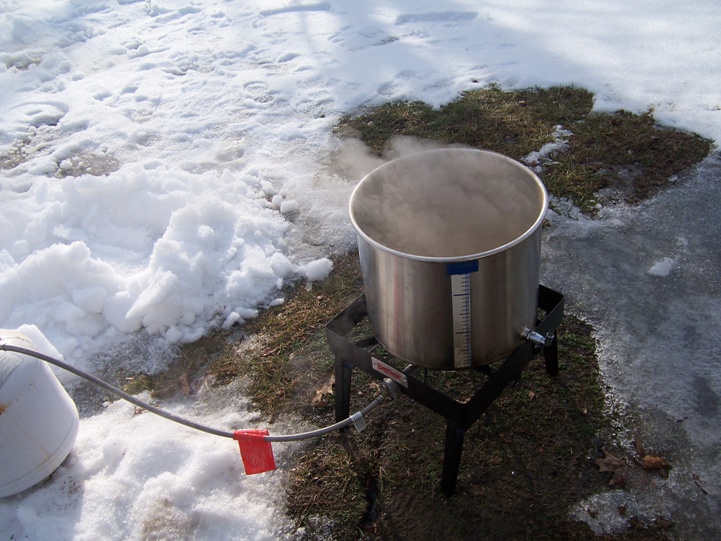
Maibock Brew Day

The brew itself had a nice caramel color.  I was able to get a 7.5 gallon boil volume going, which tested the limits of my heat source and the size of my kettle.
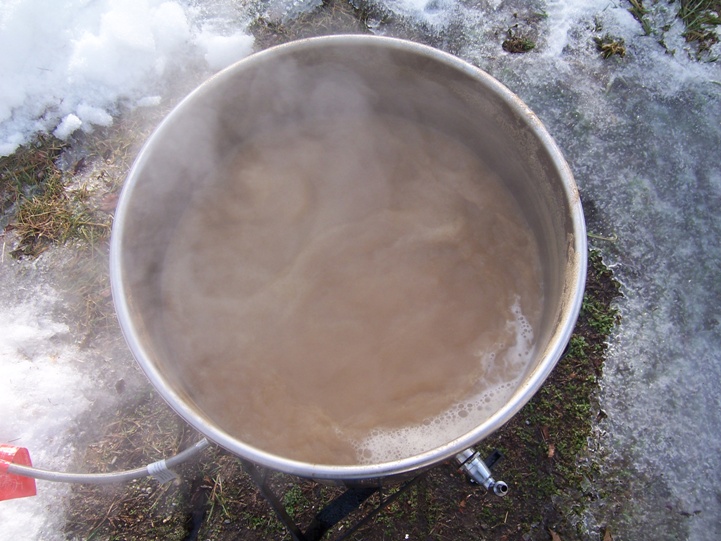
Maibock Boil

While things were chilling, I got my yeast starter out for a photo.
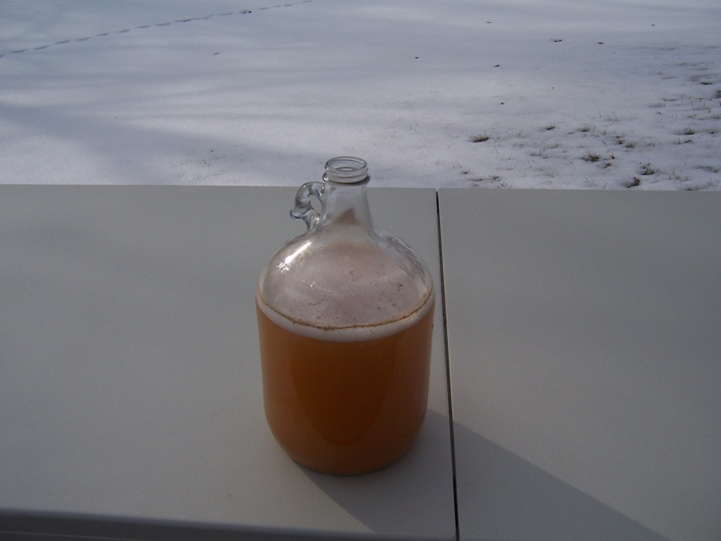
Maibock Yeast Starter

I decanted most of the “beer” off of the yeast cake at the bottom of the glass jug.  The bit that was left I used to help swirl around to get all the yeast out.
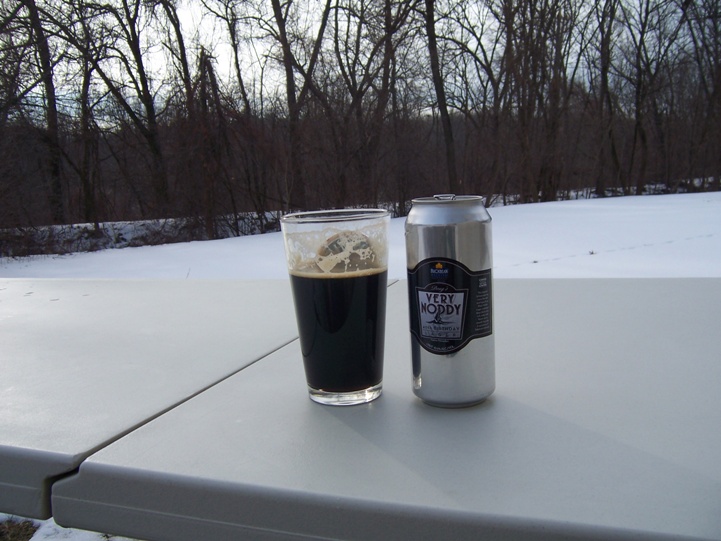
Buckbean Very Noddy Lager

While things were chilling (it took a while to get it down to the target fermentation temp – a little colder than an ale yeast temp), I was able to pour a beer we got from the Buckbean Brewing Company.  Full disclosure: They sent us a couple of cans free of charge. It was a schwarzbier, which was the other choice for my first lager. It went well with the brewing day.
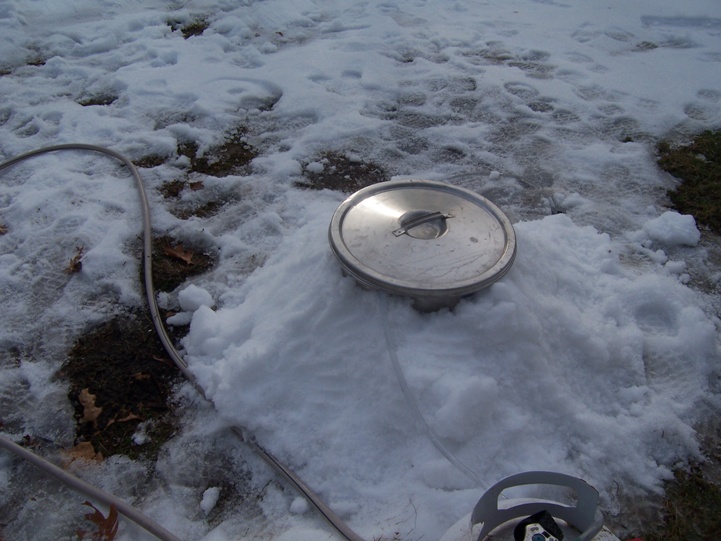
Wort Chilling

Wort chilling New England style.  I had my immersion chiller going and packed the snow around the kettle.  It still took an hour or so to get it cold enough, but I think it was faster than without snow.

Good brew day.  I hit my original gravity and pitched a good amount of yeast.  I am hoping this Maibock comes out well.

Here’s some other posts associated with this brew:
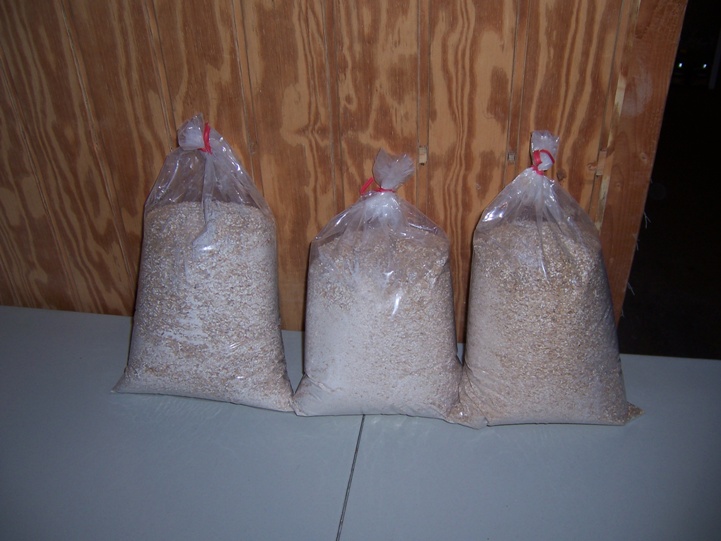
Maibock Ingredients

Maibock Substitutions

What Happens In A Yeast Starter?

I had to post this wonderful piece of information about yeast and yeast starters.  A great great brewer friend of mine, Wade, over at the BKB forums posted a reply to a discussion we were having about yeast starters and cell #s provided in the yeast packages we all typically buy from WhiteLabs and Wyeast.

Wade, a.k.a. 1n1m3g in cyber-land, is currently working on his PhD in the biological sciences arena and works exclusively with yeast for his research.  He and I have talked in the past about yeast; and he really knows his stuff.  When Wade is not working in the lab or being a great father and family man he can be found bumming around with the Boston Wort Processors, a homebrew club here in the Boston area. (Please consider checking out their upcoming Homebrew Competition)

So please take a minute to read and digest the post I have copied below.  Its a bit long, but it’s amazingly informative.

From Wade:
“OK, OK, i guess I can try to make some sort of contribution to this discussion here.  I think there is a bit of confusion here about the yeast that come in the liquid from the homebrew stores, either smack packs or vials.  There are two key terms everyone should be aware of and the differences between the two.  One is yeast viability and the other is yeast vitality.  Viability is easy to define as it basically describes the overall number of yeast cells that are alive.  If you were able to count the cells under a microscope and then plate out a small, countable number of cells onto an agar plate the viability of the yeast would be the number of cells that actually form a colony as compared to the number of cells you plated.  Vitality, on the other hand, is a more ambiguous term that describes the overall health of those viable cells.  In brewing terms, it could be described as how fast the cells could divide and as well as how efficient they are at fermenting sugars.  Cells will have high vitality if they have sufficient fermentation precursors stored up.  For example, oxygen is required to build up sufficient cell wall components prior to fermentation because during fermentation (in the absence of oxygen) these cell wall components are not synthesized and are depleted upon every cell division until a lower limit threshold is reached and the cells can no longer divide thereby decreasing fermentation efficiencies.  So, even before you pitch your yeast, you can easily have a population of cells with high viability but low vitality if not properly prepared.  For example, the older a vial or smack pack is the lower the viability is as well as the vitality, but I think that vitality drops off much faster than viability over time.

So back to the question of starters.  Creating a population of cells with high vitality requires that you give the yeast the proper nutrients that prime them for fermentation.  I think this is where Wyeast smack packs are superior to White labs yeast vials.  When you pop the smack pack you release vital nutrients to the yeast so the somewhat dormant yeast greatly increase their vitality.  There is no way to do this for White labs unless you use a starter to wake them up.  A starter is useful for both because depending on the starter technique you use you can greatly increase the total number of viable cells while at the same time increase the overall vitality of the entire population.  The most important component for the starter is oxygen.  Why force the cells to start fermentation in a starter when you are just going to pitch them into an oxygen rich wort, which inhibits fermentation, only to have that oxygen quickly depleted requiring a switch back to fermentation?  If you use a stir plate to add oxygen continuously to the starter you can greatly increase the overall numbers of cells in a smaller volume of starter wort.  These cells will have built a nice ample store of the cell wall components required for proper attenuation of your beer.  If you prefer the more traditional method of a still starter you will be better off if you give the starter a stir twice a day or so to scrub out the built up CO2 and introduce more O2.

I think a better place to add things like yeast nutrient (i.e. Servomyces) would be at pitching or a day or two into the fermentation.  The yeast nutrients add things like metal ions required for enzyme function as well as free nitrogen required to synthesize these enzymes.  Adding this to the fermenting wort of your beer will give the yeast a boost as they use up the limited nutrients that come from the malt.

I use a stir plate for my starters because I don’t use smack packs or vials, but am instead building up my population step by step from literally a single yeast cell.  I need the extra oxygen to get to the proper number of viable cells with the added benefit of also getting high vitality.  Either way, though, if you are using store bought liquid yeast, make sure the package is as close to the manufactured date as possible and if you have the capability, use a starter of any technique (stir plate of otherwise) to increase cell vitality.

Wow, is that enough of an explanation?    Cheers!”

(Standing) BREW ON!

Propane Tank Usage In Winter Time

Today is 14F here in the northern suburbs of MA. In the winter time it can be tough to brew outside if you are a propane cooker brewer such as myself. When the tank is going full bore it tends to frost up and get really cold as that liquid propane in the tank vaporizes. I don’t know if the propane actually freezes, but as it gets colder and colder the flow rate can trickle to a stand still and the boil becomes difficult to maintain.

Anyone else notice that? What do you do to combat it?

I have two tanks and two burners actually. What I do is fire off about 2 gallons of water and get it up to about 150F. Then I pour that into one of those part tubs (for keeping a half barrel packed with ice) and I put my propane tank in there. The water only comes up to the top of the base ring on the tank. The tank isn’t submerged in the hot water.

I put the tub on top of a couple folded down cardboard boxes to insulate it a bit from the floor, and I cover the top of it with a few old beach towels to help trap the steam. This seems to keep the tank from getting too cold and I can get through an entire session. If I need too I can fire up the second burner with the second tank and get a little more hot water going if necessary.

BREW ON!

Maibock Substitutions

Compromise.

Yeah, nobody says they like to do it…but they do it all the time.

I had to compromise yesterday.  Let me explain.

I wanted Magnum hops.  I had to get Northern Brewer hops.

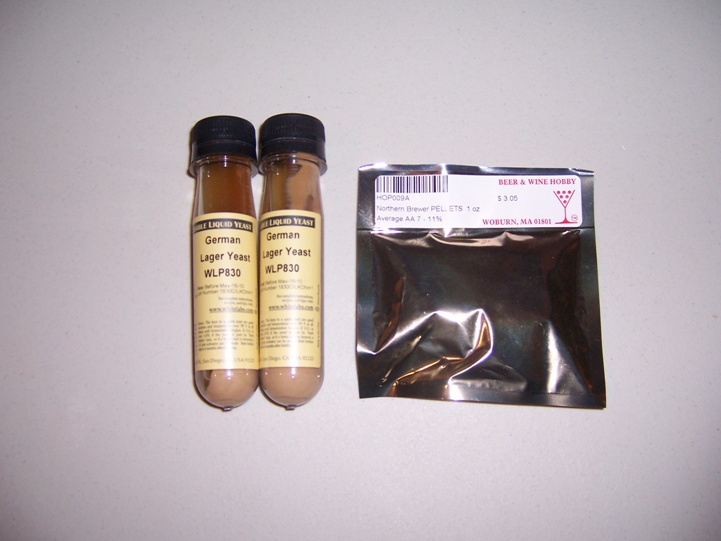
I wanted White Labs WLP833 strain.  I had to get the WLP830 strain instead.

I did get my Pilsner and my Munich malt though.  Photos below:

Pilsner and Munich Malts     WLP 830 Yeast and Northern Brewer Hops

So, it’s not going to be exactly as I planned. I still think it’s going to come out great, but just not in line with the initial thoughts.

Sadly, it’s time to tell my gift certificate giving family that I would be better off with another homebrew shop. I hate typing that but I think I need to buy from a place with a larger inventory.

BrewAdvice: The Answers You Seek

Well this isn’t an official announcement, because I don’t know when they started the site.  Looks like late last year.

But BrewAdvice is a new style of website for the brewing community. On the site members and non-members alike can ask straight forward questions and get straightforward answers.  (For example:  What is primary fermentation?)   A question may be ‘answered’ several times by many people.  As the answers roll in, the original owner of the question can select the answer that best suited the question and it rises to the top.  In theory then, if you were to go to the site and search for a question you have, you might find it was already asked and then the “best” answer is highlighted right beneath it, along with all the other answers to follow.  The advantage there is that you don’t have to read through 5 pages of comments from many different posters to finally get to the answer.

The second unique aspect is that answers and get voted up and down by users.  Questions also get voted up and down.  The process of voting also helps to drive the most relevant/popular questions and answers to the top where they are easier to find.  I like the fact that if someone who doesn’t know an answer to a question accepts an equally bad answer, people can vote down that answer posting their own answer which gets voted up.  It helps validate an answer based on what common brewing knowledge is as more like minded people vote up a “correct” answer.

As usual you can also leave comments on posts if you don’t have substantial answer to contribute, but maybe an anecdotal fact to add.

The “fun” part of all this questioning, answering and voting is that it can contribute to a members/users reputation.  Reputation is a tracking system (similar to # of posts on a forum site) that somewhat indicates how active a member is on the forum.  You get reputation points for posting popular questions that get up voted, and you get points for having your answer to a question accepted as good.  You can also down vote people too.  The sum of all this reputation tracking is that you can feel more confident about someones reply that if they had 3000 posts alone.  Because reputation can be earned and lost, it directly reflects how active AND knowledgeable people are.

Right now the site is still new.  So the reputation data being populated is still probably pretty noisy and inaccurate.  There are a couple other cute aspects that I won’t get into now.  But if you like cruising other forums for home-brewing info, you may want to go check out the site.  I won’t tell you my user name here though.  Just because I don’t want any of my fans unfairly voting up my answers and comments….(kidding).

BREW ON!

Page 244 of 322

Powered by WordPress & Theme by Anders Norén