Brew Dudes

Homebrewing Blog and Resource

The hobby of homebrewing beer

Pioneer Hops

Like Summit hops, Pioneer hops are a dwarf variety – they don’t grow too high (20+feet), more like 8 feet tall which makes them easier to harvest.  According to sources, they are a sister variety to Herald.

I couldn’t find any information about Herald so they must be the more popular sister (Marcia vs. Jan).

They are fairly new to the market and being used by a few commercial brewers.  Here’s the round up for Pioneer Hops:

Origin: UK – Wye College

Aroma/Flavor: Pleasant citrus, less aggressive than American varieties.  Well rounded bitterness.

Alpha Acid: 8 – 10%

Typical Usage: Dual – Bittering and Aroma

Beer Styles: English Pale Ales, Bitters.

Excellent Beer

Well, even though I didn’t place at the NERHBC (New England Regional Homebrew Competition), I did get the highest mark I have ever received on any entry I’ve submitted over the years.

I got a final assigned score of 42.5 for my saison.  That puts it into the scoring range of excellent.  Hey, I’ll take it.

The other surprising note is that it advance to a mini best of show round, but it didn’t go further than that.

Going into it, I was hoping to get a better score than I have received in the past.  I was looking for high-30s.  I got a low 40.  Not too shabby.

Munich Malt Flavor

I’ve been thinking about Munich Malt lately.  John did a Munich Malt profile on it back in 2008 and I wanted to dig in and bring it up to the surface again.

Last year I attempted my first Oktoberfest and went with an approximate 50/50 split of Munich to Base Pilsner malt; fairly traditional for the style.  (Of course I had a few other specialty malts in there but that’s besides the point. Recipe)  My general experience though is using Munich as a specialty grain of sorts not a base malt.  I have only added it in the <10% range of the beers I have brewed with it.  I have always looked at it as a way to add a touch more grainy/malty punch to a recipe where the other malts are a little thin.

There has been some debate in the Homebrewing Forum world about how much Munich malt is needed at a minimum to get any flavor.  Some people say that anything less than 15% isn’t doing anything that you can taste.  I am not sure about that as I seem to be pretty sensitive to Munich’s flavor profile.  That O’fest I made actually didn’t taste right on my palate (and that was before it went bad with a slimey infection).  I have always wondered since if it was because of the 50%ish Munich malt in there that I didn’t like.

Being a “day-in and day-out experimentalist” in my professional life I devised the following path to figureing out 1.  What does Munich Malt really taste like and 2. How much is too much for my palate and lastly 3. At what point does its flavor contribution drop below noticable levels?

I propose to make a batch of 100% Munich wort hopped with a 60min Magnum addition.  Lets say 40IBUs and 1.050OG.  In parrallel, I would make a 100% Pilsner wort hopped the same way and same gravity.  Then I’d blend the two worts together to make the following rations (Munich/Pilsner): 100/0, 50/50, 30/70, 10/90, 5/95, 0/100.  I suppose this would be an interesting study in Pilsner malt too.

The real trick here is the fermentation.  My first thought was to make each blend using wort in 1 gallon jugs, then ferment them each with measured yeast.  But then I need to hope each one ferments the same and I have to maintain the temp of like 6 or more jugs.  While that is its own challenge, I like the idea of each fermenting as a blend.  Because that’s how a beer would be made normally.

However it would probably be easier to pitch appropriate yeast amounts into two 5 gallon batches (100% Munich, 100% Pilsner)  and then blend them at bottling time, or even at tasting time….  I wonder if that really reflects the final beer’s flavor though.  Thinking about ease and likelyhood of actually doing this experiment… blending at tasting makes more sense.  (It also prevents me from having to do two worts in the same day)  Any thoughts?

Munich… It elludes me currently, but not for long.

BREW ON!

Blonde Ale Brew Day

Yesterday, I brewed up the blonde ale.  With Halloween festivities starting up in the afternoon, I set up an early morning brew session.

It wasn’t going to be a mammoth session like the Rauchbier, since I was only going to do an hour boil.  Plus cooling to ale fermentation temperatures doesn’t take as long as cooling the wort to lager temperatures.

This blonde ale was really an experiment into how my homegrown hops “performance”.  With this first year of growth, I got just over an ounce of hop flowers from the Magnum rhizome that I planted.

Having no idea what the alpha acid numbers are on these hops, I threw most of them in at 60 minutes and some in at 30 minutes.

I took and tasted a sample as I was racking the wort from the kettle to the fermenter.  Not absolutely sure, but it tasted well hopped to me.

Let’s see if the Magnum hops have the clean bitterness that people claim they have.  I don’t think this beer will be a hop bomb.  The hop tastes were pretty “noble” – spicy and floral, not citrusy.  It will be more in the vein of how Sam Adams hops their beers.

Scorecard

Things that went right:

– Color looked good, pretty light and blonde-ish

– I made a 2 L yeast starter and it was alive and kicking when I pitched it.  Vigorous fermentation started in less than 24 hours.

– Good boil throughout.  I made sure I had my propane tank in a pool of water to keep it from frosting up.

Things that, uh, didn’t go right:

– I need to have a better solution for whole hop brewing.  I opened the valve on my kettle, it got clogged.  I auto siphoned, it got clogged.  I poured the rest of the wort through a funnel with a screen on it, it got clogged a little bit.

– I cooled the wort to 62 degrees, and it should have been 67.  I am not sure what effect this had on the yeast, but my timing on chilling could have been better.
Racked The Rauchbier

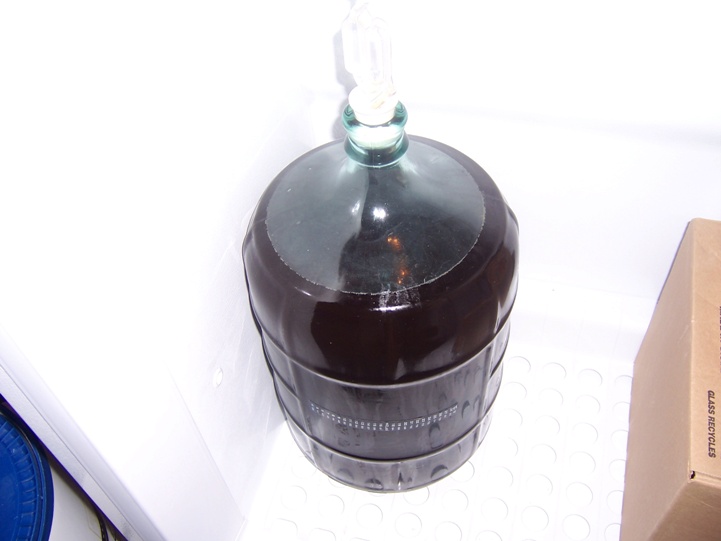
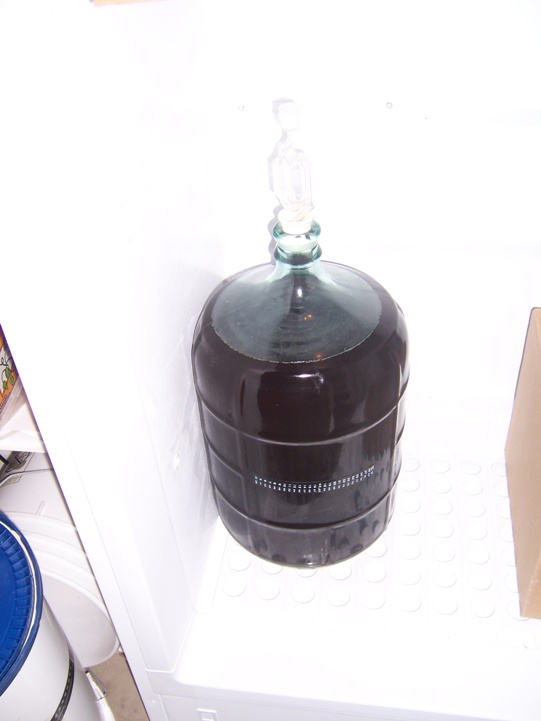
I racked the rauchbier from the primary fermenter to the secondary vessel – a glass carboy – for six weeks of lagering at 35°F in my beer fridge.

I did do a diacetyl rest.  I just took the fermenter out of the fridge and let it sit in my basement for a couple of days.  It was around 60°F in the basement.  The rauchbier is a deep, dark brown.

 Lagering Rauchbier   Rauchbier in Lagering Phase

The flash on the camera gives my beer fridge a nice Fortress of Solitude look.  I think that is appropriate for the rauchbier’s lagering phase.

I took a sample or two and tasted them.  There was some slight smoke in the nose and some balanced smoke flavor in the taste so far.

After the lagering period, I can image the other flavors will mellow out and the smoke will come pouring out.

Page 222 of 322

Powered by WordPress & Theme by Anders Norén