Brew Dudes

Homebrewing Blog and Resource

The hobby of homebrewing beer

Danstar BRY-97 West Coast Ale Yeast

Danstar has released this new strain of yeast.  Dry yeast is great for convenience and price, but often limited only by its lack of strain selections when compared to the liquid yeast companies.  I thought it interesting to note that there was something new to consider when making a dry yeast choice.

Name: Danstar BRY-97 West Coast Ale Yeast

Description: A top fermenting ale yeast that comes out of the Siebel Institute Culture Collection (not sure why its been released for commercialization through Danstar though.) Reported to be a quick fermenter, completing fermentation in as little as 4 days (at 63F!).  A medium to high attentuator depending upon the pitching conditions and temperature.  Flocculation is driven by cold crashing.  Flocculation rate my result in a minor decrease in bitterness.  A slight estery aroma and clean flavor profile.

Cell density: Greater than 5 billion cells per gram

Recommended usage: 1g of activated yeast to 1L of wort (~20g/5gal); pitch rate can be manipulated to suit beer style.  I assume higher rate would be a cleaner flavor profile, and a lower rate would generate more esters.

Overall thoughts:  Seems like a slightly more flocculating version of American Ale yeast (WLP001 or US05).  The faster ferment and slight ester quality and higher flocculation rate however makes it sound like relatively “cleaner” version of an English Ale strain.  Perhaps fermenting it at 70F would be more fruity.  I haven’t used this one yet, but it might warrant some side by side experiments.

Let us know if you’ve given this one a try yet.

BREW ON!

National Homebrew Competition 2013

NHC 2013 Update:
I have NOT entered the 2013 National Homebrew Competition this year due to my disappointment with the AHA’s management of the registration process. I’ll try not to be too wordy with this but here is a brief synopsis of my experience (shared by many others I am sure):

  1. FEB 26th –  Registration to open at 3 PM EST.  Still waiting for registration email with regional links at 2:55PM.
  2. 3:00PM – Still no email, no hyperlinks on AHA website as well.
  3. 3:05PM – Find a post with the regional links in the AHA forums from Janis Gross in response to others saying “Where’s the email?”  Her response: “You didn’t get that email?  Crap!”
  4. Log in to NY region, register my name and address etc etc…  no issues.
  5. 3:15PM – I can’t log in any beer entries.
  6. 3:20PM – See that theres 850+ entries for a 750 entry cap??? Think WTF.
  7. At 3:30 –  I have to leave work to pick up the kids, so I give up and figure I’ll check it out later from home.
  8. 5:30PM – Log into to see that the registration is shut down due to major technical difficulties.
  9. I cruise some other forums on line to see discussion of people not being able to register, not being able to pay, having paid but listed as not paid, paying twice and others see the cap exceeded for # entries in many regions.
  10. The next day, an apologetic press release comes out.  The AHA is deeply sorry. They are working to straighten out payment issues and they’ll reopen registration at a later date.
  11. MAR 3rd – I get an email from the AHA that states, “We see you registered early on FEB 26th but did not add any beers.  We assume that you did not get to enter the competition due to the technical difficulties of the day.”  A special new registration will open on MAR 6th (for people like me).
  12. I debated entering, ultimately because I said I would on the blog and I promised myself this year not to miss it I figured I would give it ONE shot.
  13. MAR 6th, 3 PM – Registration re-opens.
  14. I log in at 3:01PM, no problem.
  15. I add three beers, no problem.
  16. I hover my mouse over the AHA renewal button for an extra $38 dollars and think…. not yet.
  17. I hit the pay for entries button and go to the credit card form page, no problem.
  18. Enter all my info and credit #, hit submit at 3:15PM.
  19. ERROR page.
  20. I go back reenter one time, ERROR page.
  21. I’m out.
  22. I get an email from Ian Stevens, member services AHA at 4:30PM.
  23. “We see you logged in and attempted to pay but failed.  We experienced a problem with the payment system during a small window after registration opened. That problem has been fixed and we want all that have registered entries to get a shot at entering.  Please pay now to reserve your spot.”
  24. I politely reply: “Fool me once, shame on you.  Fool me twice, shame on me.  You want me to go for a third time???  Wow.”
  25. I log back in and delete my three entries.

I’ll close with this:

I have been listening to podcasts such as The Brewing Network and Basic Brewing Radio for over 6 years.  I have also listened to and read things from brewing greats like Jamil Zainasheff, John Palmer, Gordon Strong, and many others.  The NHC comp has always been this pinnacle of brewing competitions to me.  The AHA is a paramount organization that all other brewing clubs rally around.  Perhaps I let the NHC get to built up in my head, but I am extremely disappointed that the AHA failed to handle this process better in advance; but moreover, had it corrected for the second submission date.  You’re either a premiere homebrewing organization, or you’re just another local outfit that does the best it can.

The AHA is a great organization that supports the cause of homebrewing across the country.  I told Ian Stevens that I’ll still support the AHA, but that I’ll just be doing it from the sidelines this year.  I’d rather spend my $50 dollars of entry fees on brewing.  Call it voting with your wallet, if you will.  Hopefully they’ll actually learn from their mistakes this year and get it right next year.  Maybe I’ll try again then.  I’ll hold no long term gripe, but for this year I’m out.

FEB 3 2013 Original Post:
This post is probably more for me than it is for you, dear reader. Well, maybe the reminder portion of this post.

Every year I vow to submit a couple beers to the American Homebrewing Association’s National Homebrew Competition.

However, it always creeps up on my memory and by the time I go to check the website, I’ve missed the registration deadline.

But not this year! This year I’ll be sure to submit to the National Homebrew Competition 2013.  Online registration begins February 26th at 3PM EST.  From what I have heard in past years, it’s important to know what beers you are registering and get on the ball because the first round judging sites fill up quickly. You might be able to ship to a different site other than your first choice, but then your shipping costs may go up. I guess NY will be my location of cchoice.

Entries require two 12 oz bottles.
Entries are accepted at the specific shipping/drop off locales between March 18 and the 27th.
A maximum of 15 entries per person has been imposed this year. (I am not submitting that many, maybe two).
They haven’t posted the official rules PDF yet, so I couldn’t figure out what the entry fee was.  However, I did see they upped the fee by $2 per entry.

I am not hoping to place and/or win, but that isn’t my intent.  My hope is to see if the quality of the feedback I get from the NHC is better than any “standard” competition that’s around.  I hope to send in some Oatmeal Stout and maybe the Falconers Flight IPA because it will be the freshest thing I have on had at that point… but I could brew something else up in time. We’ll see.

What say you? Any fellow competitors out there?

BREW ON!

Submit Your Homebrewing Experiment Ideas

Man, that six pack of New Albion Ale lasted a long time – three weeks somehow.

Ok – clearly we got three videos out of one sitting but I think it made sense to break up the time into these three different posts since we had three distinct topics.

This time around, we ask if you have any homebrewing experiments you’d like us to conduct.

We have conducted experiments in the past around priming sugar and yeast strains. Soon, we’ll have some information about how to treat your water for better beers.

But is there something you’d always like to test out and haven’t had the time to do so? Let us know. You can email us (see our Contact page) or you can leave a comment below.

I will get us started:

I’d like to do a Hot Side Aeration experiment where you essential brew the same beer three times, one being as careful as you can transferring the hot wort around, the second one would be to abuse the wort as much as possible to aerate it as much as possible, and the third one would be done as normal. After the 3 beers were ready to drink and had aged in the same conditions for some period of time (months), it would be interesting if you could taste a difference.

Don’t be shy – submit your homebrewing experiment ideas today.

Braggot Brew Day

Yesterday, before most people were awake in the neighborhood, these Brew Dudes were up to some homebrewing activities.

The main attraction was a braggot brew session. I did a small mash (5 pounds of grain) and 1 addition of hops for the full sixty minute boil so the kettle didn’t need constant attention. We checked on it just to make sure it was still rolling with the boil.

While that was going, we bottled and corked the cyser that had been conditioning since December in my basement. Even though we discovered that my auto-siphon had a big crack in it, the transfer from carboy to bottling bucket went okay.
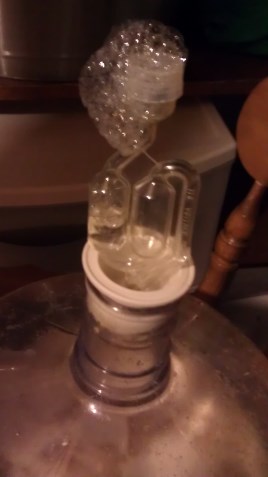
The airlock is bubbling in more ways than one.
This cyser was the first brew I have ever corked. The newfangled corking device that Mike bought for his foray into wine this past fall is really easy to use. With slightly less than a gallon to package, I was able to cap three 12 ounce bottles for competition and cork three wine bottles for consumption at a later date.

Then, we bottled the Scottish 70 shilling ale. I drew a sample off of the carboy just to get an idea of the flavor profile. That yeast strain does some funny things. There was a definite peat-y note to it. I can’t wait for it to condition in the bottle for a few weeks to see how it is when it matured a bit.

With the Scottish Ale bottled and the wort chilling, 6 pounds of honey was poured into the just emptied carboy – right on top of the yeast cake.

This raw honey was slow moving. It took a while for it to run through the funnel. Once I got the wort cooled to fermentation temperatures, pouring the wort on top of the honey helped to move things along.

I did add a little yeast nutrient and energizer to the carboy before I sealed it. Within two hours, the airlock was bubbling pretty intensely. Hooo boy.

Brew On!

Town Water Report

We did some searching around and our local water district posts a water “confidence” report for our area. We get our water from a combination of 4 deep wells in the area apparently.

They are fed by a major local river and replenished by two other regional streams, at least that’s how the report puts it.  While the water report lists things like benzene, arsenic, and chlorodibromo-methane (all below levels of detection -thank you); it does indeed list a couple of useful brewing related minerals.

In short, our town water report mentions these minerals:

  • Calcium- 26 ppm
  • Sulfate – 17 ppm
  • Potassium- 29 ppm
  • Alkalinity (CaCO3) – 51 ppm

Our town does use a little chlorine, but it was listed as parts per billion. Our water out of the tap has no detectable chlorine taste. What little there is likely off gases fairly quickly.

The nice thing is that there is no mention of Chloramines in the water.

So, at first pass, these few minerals seem to tell me a few things.

Our water is pretty soft, meaning low overall mineral content.  This is good news because its always easier to add to your water salts you don’t have, than take away excess of minerals you don’t want.

The other thing that is striking to me is that our Calcium is fairly low.  A general brewing guideline for Calcium is 50ppm to 150ppm.  Calcium is interesting to me because while my beers aren’t overly hazy, they are generally cloudier than they could be, but they get better with time.

Calcium is critical to yeast metabolism but also yeast flocculation which produces a slightly cloudier profile that goes away with extended “lagering”.

Another potential result of our water is that I often feel that when I brew hoppier beers from established recipes the hops don’t seem as exciting as the recipe or the original brewer seemed to intend.  This is likely directly correlated to the low sulfates in the water too.  Sulfate tends to accentuate hop bitterness and creates a crisper presentation in the final beer’s hop to malt balance.

That’s the first pass look at our water. We are actively looking into and preparing to compare this to a sample sent to Ward Labs for a water analysis.
Comments are always welcome especially on this new and challenging topic.

Page 172 of 322

Powered by WordPress & Theme by Anders Norén