Brew Dudes

Homebrewing Blog and Resource

The hobby of homebrewing beer

German Pilsner Brew Day

On Sunday morning, I got up and brewed. The style for today was a German Pilsner.

As you can see on the aforehyperlinked recipe, the grain bill was simple. There were no specialty malts to speak of, just a bunch of pilsner malt. I opted for the floor malted version of Weyermann’s pilsner malt for something different.

My mash was low and slow. I got the mash temperature to 147° F and let the mash do its thing for 90 minutes, just to be extra sure I got a full conversion.

The boil was long too. It went on for 90 minutes to reduce the chances of DMS in the final beer. I made sure I had enough wort to accommodate the 30 minutes of additional evaporation time to get 5.5 gallons in my fermentor.

A few things I did differently for this beer.

  • I used distilled water for half of the total amount of water I needed for the brew
  • I added some gypsum to the water I used for the mash and some to the boil.  It wasn’t that much, it was 4.5 grams in total.
  • These things were done based on the water report we got back from Ward Labs and using water chemistry calculators to get it into the range for suitable water for a German pilsner.
  • I remembered to use a Whirlfloc tablet to help with clarification.  I didn’t use it for the Bohemian pilsner I brewed last year and I was unhappy with the clarity of thatbeer.

Since it was hot day, I wasn’t going to be able to chill the beer to the temperature I wanted, which was 44° F.  I got it down to just under 70° F, transferred it to my cleaned and sanitized carboy, and put it into my fridge that was temperature controlled to the temp I wanted.  Eighteen hours later, the wort’s temperate was where I wanted it to be so I aerated and pitched my yeast starters after decanting a good amount of the starter beer.   I am excited to see what activity is when I get home tonight.

Here are some photos showing the cold break and the starting gravity reading that is just above where I wanted it to be.
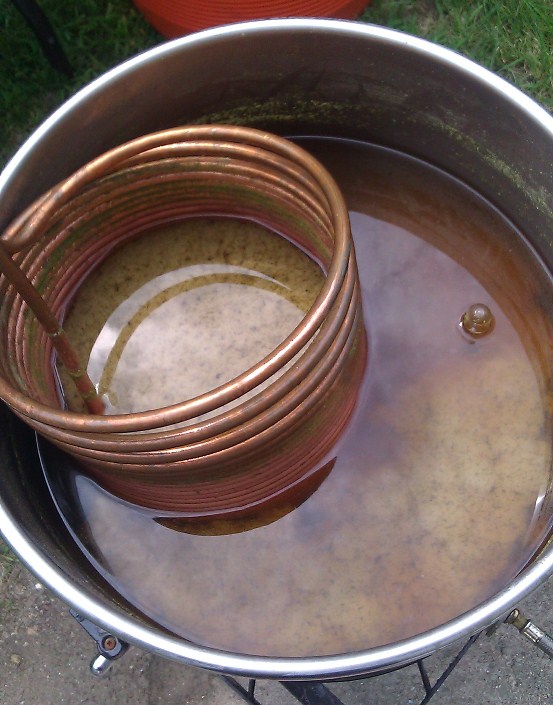
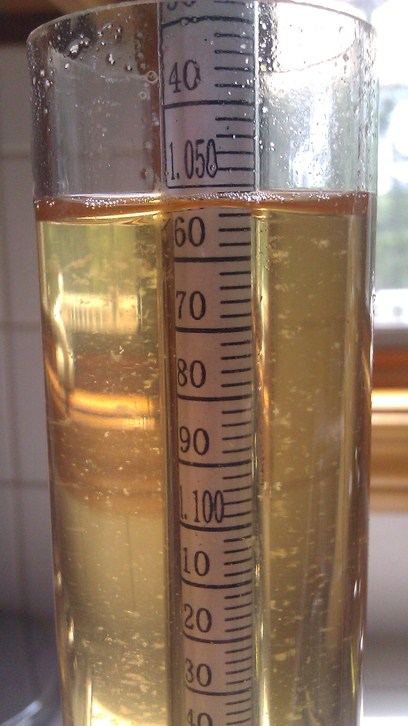
Lots of cold break in this German pilsner wort German Pilsner Gravity Reading

Pilsner Yeast Starter

As we have learned, a big healthy pitch of viable yeast is key to excellent beer.  That’s why I made a mighty pilsner yeast starter.

Using mrmalty, the style called for a starter that would equate to 3.64 vials of yeast.  I rounded up to 4 vials of yeast and I knew I could get there by making a 4 liter starter for 2 vials of yeast, which I purchased for the German Pilsner I want to brew.

Because I don’t have a suitable container to ferment one 4 liter yeast starter, I made two 2 liter starters for 2 vials of yeast – one vial for each.

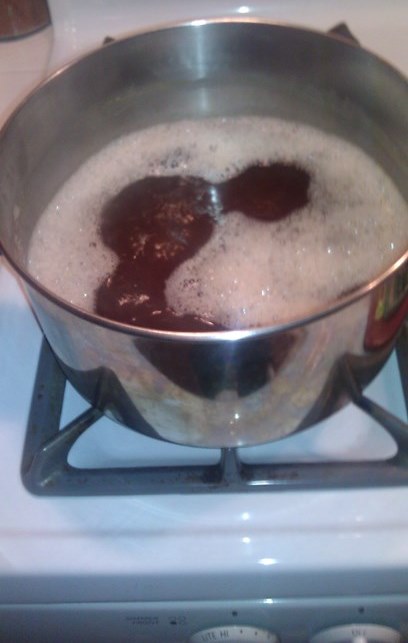
Each wort was boiled on the stovetop in its own pan since I thought it would be easier to do the measurements before the boil rather than after it was done. Here is a photo of one of the pans.

Pilsner Yeast Starter Boil

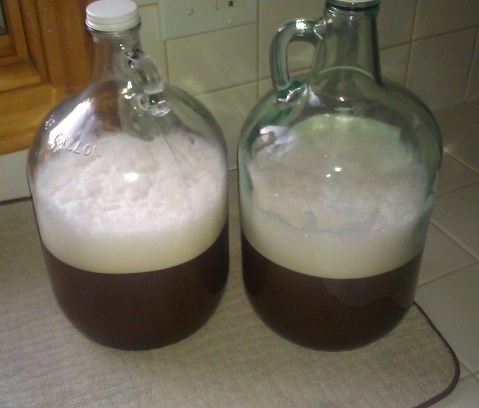
After each wort was cooled to room temperature, I poured them into the large glass bottles that I do own.

The contents of each vial was mixed in with the simple wort that I made with malt extract and a little yeast nutrient. I shook each bottle to aerate as much as I could at the beginning and throughout the day.

Pilsner Yeast Starters

The caps on the bottles were sanitized and placed on the tops of the bottles loosely so that gas could escape.

After all these years, I am still uneasy about the yeast starter process. I feel like I follow all the instructions to make them but I still worry if the starter produces enough yeast to have a really clean and vigorous fermentation.

I have had good fermentations from what I have done before. I still think I could have better ones and that it would be solved with having a better yeast starter. The thing is, I really can’t tell the difference between a great starter and a good one.

Hefeweizen Tasting Video

Summer time is a great time for beer. I have had a long history of brewing wheat beers. Many years ago I can remember drinking pitcher after pitcher of great German style Hefeweizens.

Somewhere along the way, I lost my taste for them.

Recently, I had started doing research into Hefeweizen again. In my research, I discovered things I already knew but never put into the front of my mind I guess. I think the reason Hefeweizen fell out of favor with me was that I wasn’t really getting fresh enough examples anymore. As my beer palette was maturing, I didn’t realize that the freshness factor needed in most all styles of wheat beer was so crucial. I assumed I just didn’t like the taste of Hefeweizen anymore. (It made be quite sad, because those pitcher sessions with great friends is still a vivid memory for me.)

So I decided to take a simple approach to brewing a Hefeweizen. I wanted to brew it quick and drink it early. I wanted to use ingredients I was comfortable with and liked. I also wanted to restrain the fermentation character a little bit to avoid maybe generating too “hefey” of a taste; if that even makes sense.

What I have is a great thirst quencher laid out in this Hefeweizen tasting video.

I fermented this one on the really cool side, 62F.  I the banana esters are really muted and the clove character is the only thing really hinting at all that I used the classic WLP300 Hefe strain.  Even at that the clove character is pretty muted too. Just enough to make the beer appear “spicy” but that could just as easily be coming from the East Kent Goldings hops.

Lastly, there is a pretty cool twist in these beer. For the Pilsner malt, I used traditional continental german Pils from Weyermann. But for the wheat portion I used malted wheat from Valley Malt in Hadley, MA. They are a “craft” malt house bringing small batch malting back to the local markets here in MA.

Both John and I really enjoyed this beer. It is a going to be a great summer drinker but you’ve got to drink Hefeweizen quick (or at least I do). At the time of this writing its been about two weeks since the video was shot. The beer is still drinking nice, but some of the bright edges are starting to fade. I want to save some it to do a side by side with a wheat beer John has going… but I am not sure. If it starts to take a deeper turn, I’ll have to crack open the liter mugs and start getting this one down.

So give this style a second look. It is not too late to brew up a great Summer Hefeweizen.

Brew on! I’ll post the full recipe separately soon. Enjoy the video.

The State of Homebrewing in 2013

The AHA had an article on the hobby of homebrewing and its growing popularity. It was focused on the increased business of homebrew shops. If percentages are your thing, the shops that were surveyed reported a 26% increase in sales from 2011 and 2012.

I looked into the trending of homebrewing popularity a few years ago by using some online tools.

The data that came back was contrary to what I thought was happening. The data made it appear that the hobby was decreasing in popularity.

Knowing the growth in craft beer, I would assume homebrewing beer would be growing too. This survey confirmed it from the homebrewing supply shop side of the equation.

I type this post happy that the hobby is becoming more popular. More homebrewers is a good thing and more homebrewed beer is an even better thing.

The one thing that I am a bit wary about with the growth of sales is the increase in prices on homebrewing ingredients and accessories. Last week, I bought a few items at a homebrew shop that is near my new place of employment. Some of the things on my list were the largest size of both Powdered Brewery Wash and Star San sanitizer that they had in stock. I brought my stuff up to the counter and the guy at the register commented on my choices of the biggest size. My reply explained that buying in bulk makes sense for me.

The total came up on the register and it seemed a bit high at first glance. I paid and looked at the detailed receipt as I walked out the door. Both the PBW and the Star San were easily 7 to 10 dollars more than I have paid at other shops or online. I was a little floored by the markup.

Hey, I don’t blame a business trying to make a buck but price gouging is not something I can support. WIth increased demand, you can charge higher prices but the buyer can get around it by checking out other options.

Now I could out them here in this post, but that’s not my style. I could tweet them and ask them about it but the time has past to tweet.

At this point, I have to chalk it up as a lesson learned or at least a lesson reminder. In this growing hobby, make sure you compare prices and you won’t overpay if you take the time to avoid overly high prices.

Saison Throwdown

This summer, Mike and I are going a saison throwdown.  What’s a saison throwdown, you ask?  I am not sure either. Actually, what we are going to do is brewed saisons this summer and see how they compare and contrast with each other.

We did an oktoberfest duel a few years ago so we will do the same thing but this time we will be brewing saisons.

Maybe we will bring in others to drink them and see what they think.  We can make a video tasting about it and make it an event.  Certainly  we can put them into a competition too.

It’s been a while since I brewed a saison but I do have a passion for these farmhouse ales.  At the American Craft Beer Fest, it seemed many of the booths had a saison to offer.

Clearly, saisons are sooooo hot right now.

I really enjoy the process of brewing saisons.  One reason is that you can let the fermentation temperatures run wild – within reason.  Too hot and yeast will die but in the dog days of summer, you can be lax with where you store the fermentor since warmer than typical temperatures work wonders on the finished beer.

The grain bills can be full of experimentation too.  There aren’t strict guidelines for the style in terms of specialty grains but I like using different Belgian grown malts.

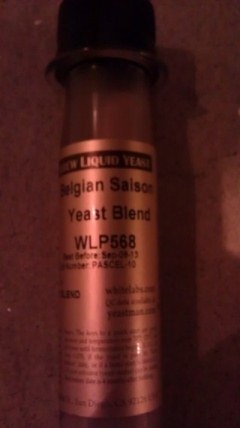
With saisons, the yeast is the thing.  I was mulling over yeast strains and I was able to buy a vial at the Homebrew Emporium.

Saison Blended Yeast

This is a blended strain from White Labs and I am interested in seeing how it will perform. I think this is a combination of Belgian and French saison strains. I have had success with other strains that other homebrewers have said are problematic and I hoping I can brew an excellent beer with this blended stain.

So let the challenge be thrown down. It’s a summer of saison.

Brew On.

Page 163 of 322

Powered by WordPress & Theme by Anders Norén