
Brew Dudes

Homebrewing Blog and Resource

The hobby of homebrewing beer

Making Cider – 2013 Edition

I am going to attempt to not type the word “hard” when describing what I put together tonight because what I made should only be known as cider and nothing else. Everything else is juice.

This past weekend, the whole family went for forty minute drive to Cider Hill Farms in Amesbury, MA. After purchasing a “special blend” juice from my local homebrew shop which turned out to be the same pressed juice I could have bought in my local grocery store for a buck cheaper per gallon, I decided that I would source my own juice.

Some year, we’ll have to plan another pressing but until then I will source my juice and ferment it without all the manual labor.

I believe Cider Hill does a good job of blending sweet, sharps, bittersweets, and bittersharp apple and the juice they sell makes for a good base for cider. The price is in the same range for premium, pressed, unpasteurized juice with no preservatives added. Plus, the kids got to see chickens, eat doughnuts, and pick more apples for home.
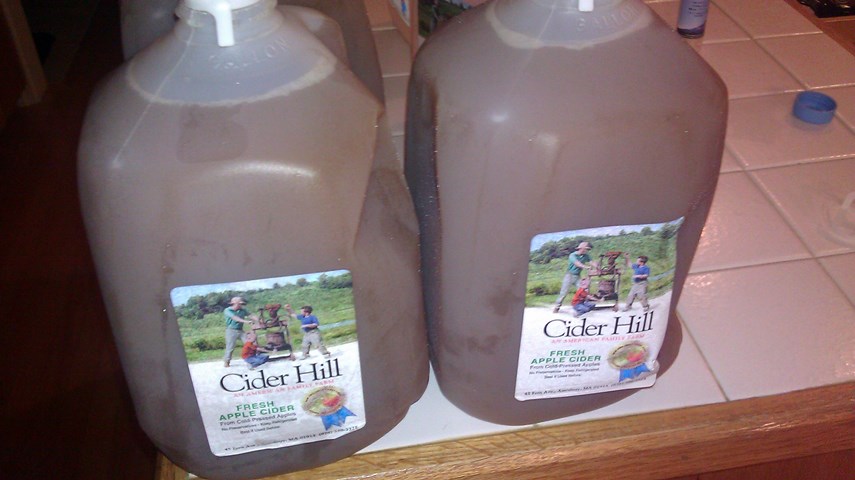
Cider Hill Farms Juice

I am using my New England Cider recipe as a guide this year. This year, I am using 5 gallons of juice and I think I am using mostly honey as my adjunct to get the sugar levels above 1.070.

I put in two pounds of honey, a half pound of brown sugar, and a pound of white sugar and that got my starting gravity to 1.072. I read some recipes had the sugar addition bringing the starting gravity to over 1.090 but I guess I am not ready for that jelly. I like it to be just high enough.

Without judge feedback from the last one I made, I am left with doing it the best way I know how. Besides, I like the way it tastes.
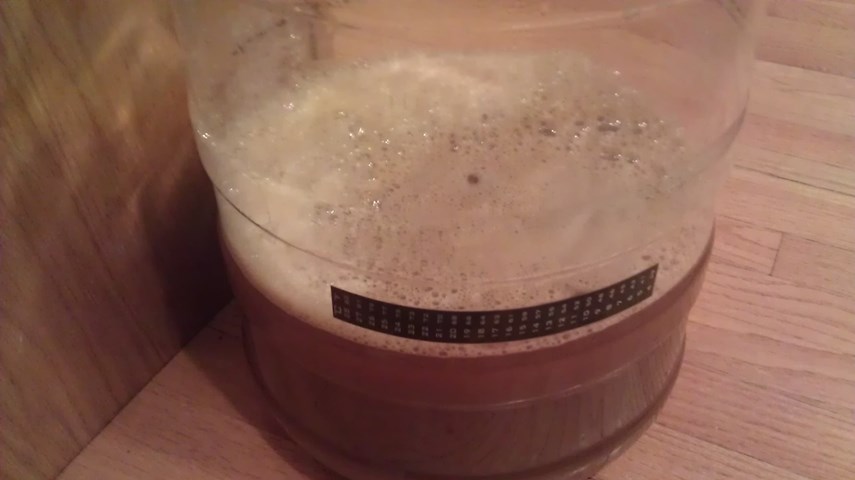
Cider in Carboy

Brew on!

I added raisins to this cider later on. They looked weird floating in the carboy.

Check out the bottling notes for this cider.

CHECK IT – the cider tasting video!
Placing At The NERHBC

Yes, I did submit 7 entries to the New England Regional Homebrewing Competition (NERHBC) and one of them placed.  I was awarded first place for the European Amber Lager category – Category 3.

The Vienna lager which received a second place award in the Boston Homebrew Competition had aged nicely over the last 8 months.

If you asked me which of my beers would place in this competition, I had four entries ahead of the Vienna.  I thought my German Pilsner had a shot but there was no love.

Here is what I submitted:

1. German Pilsner

2. American Wheat

3. New England Cider

4. Oaked Medium Mead

5. Vienna Lager

6. Dusseldorf Altbier

7. Doppelbock

The first four were the freshest of the bunch so I thought they would perform the best.  The Alt and the Doppelbock were always “just ok” in my mind.  These 7 were the best of what I had on hand so having a “just ok” beer was better than the “not so great” beers that I did not send in.

The NERHBC is a Masters Championship of Amateur Brewing (MCAB) qualifying event so I gather I can enter the Vienna into that competition at some point in the future. Maybe we I get the sheets back, I will have some more information about the MCAB.

With any competition, I am curious to see what the judges thought and to see if I can improve what I brewed. The New England cider is one I would like to see what they had to say since I am poised to make another one this week. Yesterday, I brought the whole family to Cider Hill Farms in Amesbury so I could buy five gallons of their juice. If there are any tips, it could help me make a better one even though I thought the one I made last year was pretty darn good. We’ll see.

Thanks for reading. Brew On.

Black Lager Recipe

Sometimes your beer drinking friends will put in a request for a brew.  A few years ago, I got asked to brew a Rauchbier which was received well.  This year, there has been a call for a Yule Lager.  Outside of a play on words,I am not sure what kind of beer that is.

I started to think about how I would brew this beer and the idea of spices came into my head.  That thought only lasted a few moments since I don’t want to brew a spiced lager.  Instead, I thought I would brew a black lager with a hint of roasty flavors.

This beer is similar to my Schwarzbier recipe but it has a few other malts that really don’t need to be there.  I am hoping to get some roasty, chocolately flavors in the finished beer.  That should be enough for a yule lager for holiday cheer.

Pre-Boil Volume: 7 gallons

Post Boil Volume: 5.5 gallons

Ingredients:

7.25  lbs Munich
3.25 lbs Pilsner Malt
4 ounces Roasted Barley
4 ounces Weyermann Carafa Special® TYPE II
4 ounces Chocolate Malt
.5 oz Magnum pellets, 14.5% AA – boiled 60 minutes
0.5 oz Mt. Hood pellets, 4.5 %AA boiled 15 minutes
0.5 oz Mt. Hood pellets, 4.5 %AA boiled 1 minutes
Yeast: White Labs WLP830 German Lager

Predictions:

Original Gravity: 1.050
Terminal Gravity: 1.013
Color: 23.09 °SRM
Bitterness: 27.0 IBU
Alcohol (%volume): 4.8 %

Instructions:

Prepare a large yeast starter a few days before your brew day or buy the appropriate number of yeast packages for a proper fermentation (use a yeast pitching rate calculator).  Mash grains at 156 degrees F for 60 minutes.  Boil for 60 minutes and add hops to boil at appropriate times.  Chill wort after boil to a temperature of 48 degrees F.  Pitch yeast and let the wort warm up to 50 degrees F for about 2 weeks or until your terminal gravity is met.  Keg or bottle as normal.

I will be using my homegrown hops for this recipe.  They should give this beer some noble/floral aromas and tastes.

Check out the brew day for this recipe!

Watch the video with our tasting notes!

Brew On!

2013 Sprint to the Finish

When we enter the final three months of each year I begin to reflect on what I’ve been brewing and what I thought I’d be brewing when the year began. I find its a nice opportunity to try and plan out what last few things I could squeeze in to feel like it was a great brewing year.

In my case, I like to think that I am learning and improving along the way. This year both John and I did a little experimenting with the relationship between water ions and hop profiles. For, us that was really the biggest technical aspect of our brewing growth.

We had other goals as well that are more Brew-Dudes related as well.

Looking back I find that most of my brewing was for beers that I wanted to drink or beers I wanted to make for other people to drink. Ultimately, that’s what brewing is about; making the beer you want to drink.

I still have an arms length of things I might try and grind out before years end. A Porter, another special IPA, and a Munich Helles. Both of us are also preparing for another brewing Throwdown, this time something we are calling a Yule Lager. We’ll talk more about that in videos to come. John is planning a big and complex Weizenbock as well!

Enjoy our ramblings and remember its not to late to squeeze in that last brew you forgot to do or was to busy to brew months ago. Fall is a great time to brew just about any style.

What still remains on your 2013 brewing goals?

Brew On!

Travelling For Beer Research

As a homebrewer, you should always be seeking out examples of beer styles to learn how they taste.  There is only so much you can learn from the descriptions written in books and on websites.  If you really want to know about beers from a certain region, you should taste them there fresh.

I was in Switzerland on a whirlwind trip last weekend.  Although not a highly celebrated country for beer brewing, it does have a number of breweries still doing it the way they have been doing it for hundreds of years.  Also, its proximity to powerhouses like Germany made it great for me to get fresher examples than what I would be able to get at home in the USA.

To have Budweiser Budvar at my friend’s house made me realize that I could brew a Czech/Bohemian pilsner with a lot more Saaz hops than I did when I brewed it last year.

Visiting a small regional brewery and trying their zwickelbier made me aware of a style that I hadn’t read about in any guidelines.  Sometimes you find styles that are so rare, they are confined to the region they are brewed in.

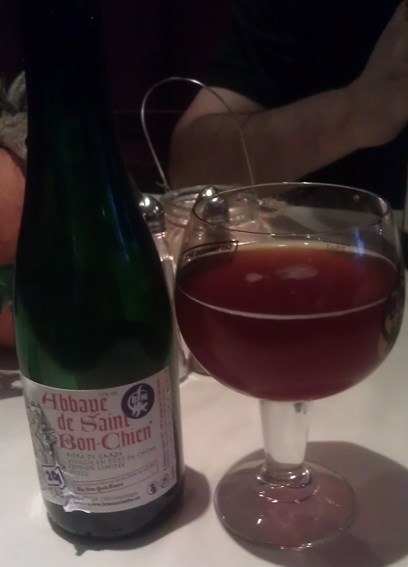
Lastly, if you find the right places to visit, you can find local versions of styles.  These are breweries that don’t distribute to far away places so you must seek them out.  I had a Biere de Garde from the Brasserie des Franches-Montagnes that was superb.  This is a style that I have only had from a few USA craft breweries.  To be able to taste a fresh version of this style in the Old World was eye opening.


BFM Biere de Garde


So I guess the point I am trying to make through all my jet lag and exhaustion is that travelling can help your beer brewing the same way brewing beer more often will.  You need to experience life to improve.  You need to drink fresh beer rather than read about it.  Stop reading this post and go get some beer knowledge.


Brew ON!


Page 153 of 322

Powered by WordPress & Theme by Anders Norén