Brew Dudes

Homebrewing Blog and Resource

The hobby of homebrewing beer

Saison Redux

Second chances are tough to come by. Thankfully, homebrewing is more forgiving. Don’t like a batch simply try again! That’s what John did with a new attempt at Saison. A tough but popular style to brew well. We compare last years to the new batch head to head.

First off last years batch is visibly different. Darker. Is that age or recipe? It did t really matter once you tasted it. It had some strong dead yeast character. A touch of oxidation. And a minerally finish the was just plain weird. I described it as hammy.

The new batch was bright and vibrant. A balance between slight acidity and a Belgian phenol and ester character. Where the acidity comes from is hard to say but it works here and works well. The beer is definitely dry as we have come to expect from Belle Saison yeast. Interestingly my Saisons with the same yeast were more restrained when it came to that Belgian character. My best attempt being more citrus like.

It’s interesting to wonder how much the base grist recipe plays in the final product. Seeing as most Saison yeast will take you well down into single digit SG readings one must begin to think that the yeast must be digest some of the dextrins. And if different dextrins are present from different grits you could envision significant variances between beers brewed with the same yeast. More research to be done is suppose.

There you have it. Don’t give up in a style too soon. Taste, learn and rebrew.

BREW ON!
Harvest Lager Brew Day

Hey there. Hope your brewing adventures have been going well. Yesterday I had time to brew up my Harvest Lager using home grown hops and a Mexican Lager strain.

Recipe Thoughts

The grain bill is simple. I got a nice American pale malt to mill along with a pound of 60⁰ L Caramel malt. I planned to make an amber colored, sweet wort that would go well with all the hops going into the beer.

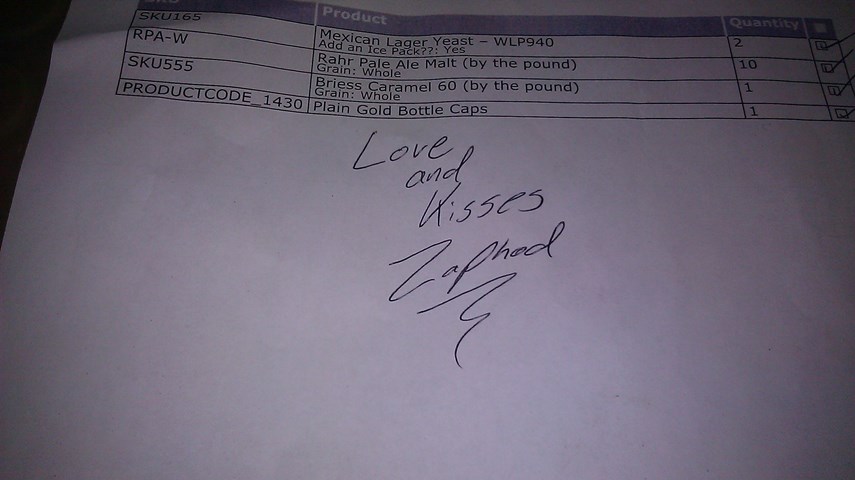
I bought all the ingredients I needed from Rebel Brewer. These guys like to send love notes along with their packing slips.

Rebel Brewer

How sweet.

Hop Additions

I re-read my notes from last year’s harvest brew and it was clear I should add more hops to the kettle. I started off with an ounce of my Magnum hops once the boil started rolling. These hops do very well in my beers. I have brewed with them for many years now and they provide that same clean, smooth bitterness as the hops I buy in the stores do.

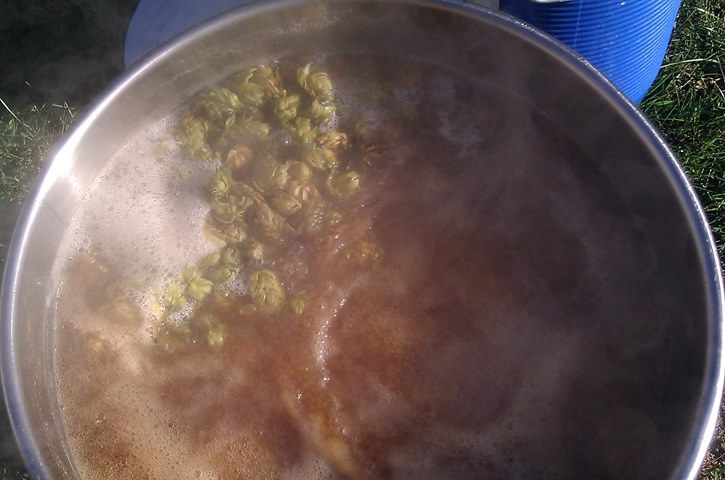
Then, with 20 minutes to go in the boil, I added an ounce and a half of the home grown Mt. Hood hops. In the past, I would put in just an ounce, and I am hoping a little bit more will work. Thinking about it, I should have added a full two ounces. Next time.

Hops in the full boil

Once the boil was done, I did add 2 ounces of Mt. Hood hops to steep before the chilling began. Because there were so many cones in the kettle, I put these hops in a fine mesh bag and shoved it under my immersion chiller so that it would stay submerged. After 20 minutes of steeping, I ran the water through my chiller and started to bring the temperature down.

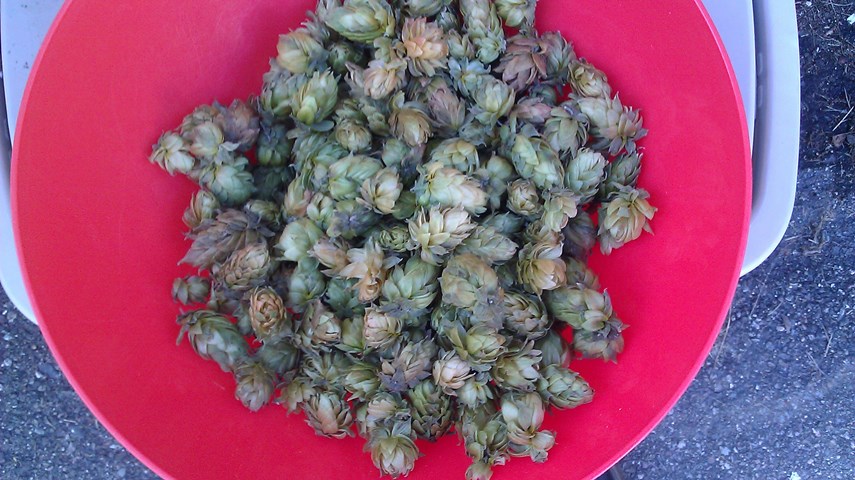
The plan is to dry hop right before the end of fermentation with probably another 1 to 2 ounces of hop cones. I will have to see how much I can get into the carboy when the time comes.

2014 homegrown hops for lager

Mexican Lager Yeast Starter

For this brew, I bought two vials of White Labs WLP940 Mexican lager strain. I made two 3 liter starters and it’s a good thing too. One of the vials had an expiration date of October 9th which on brew day was only 4 days away. Of the two starters, that one took an extra day to get started. By the time I pitched it, it was at the peak of fermentation. I am glad I went through the steps of making a starter. If I hadn’t I would have had some sluggish yeast and it probably would have produced a crappy beer.

Making yeast starters has majorly improved my beer brewing. Get into them if you haven’t already.

Culturing Belgian White Ale Yeast

Not ever satisfied with mediocre beer John tried his hand again at brewing a Belgian White Ale. However, he ordered the wrong yeast strain when he purchased the fine kit from Northern Brewer. Facing a potential failure before he even started a new plan was devised. Culture up some bottle dregs and brew that White Ale something proper!

John tried a culturing Belgian White Ale Yeast from a few different sources. Ultimately, Allagash White work out the best for him. He propagated a small starter from a few bottles and then stepped up the starter to an appropriate size pitch.

The end result was a great beer that was actually reminiscent of Allagash and Hoegarten. Both great Belgian White Ales. The beer had a excellent malt aroma with floral accents of coriander and lavender or chamomile. The flavor was slightly spicy and very dry. Fully attenuated the all the beer flavors seemed to pop out nicely. That level of attenuation certainly speaks to how well the yeast culturing went.

This beer had a nice nobel hop character to it backed with a solid grainy presence which we think was the oatmeal portion of the grist coming through the predominant Pilsner malt backbone. Very well balanced recipe. As the beer warmed we could finally make note of the bitter orange peel that went into the late boil.

Interestingly, this grist and yeast combination didn’t lend much of any citrus notes. At least not to my palate. I prefer a witbier to have a little more citrus character. However, some people don’t care for it. John’s example lends itself to more flexibility to the drinker. You could easily squeeze a wedge of orange or lemon in this one if you prefer that. Maybe next time I drink one I’ll give that a try.

Overall, it was a successful attempt at culturing up some yeast from the bottle. Interestingly, we could truly identify the yeast character as distinctly Allagash. Being that we only live less than two hours away from Allagash we get Allagash White quite a bit here and are very familiar with the beers’ taste. It was pretty cool to see that replicated at the home brew level.

Got any experience with bottle dregs and making a classic example of your favorite beer style? We’d love to here about it. Drop a comment or send us an email.

BREW ON!

WLP940 Mexican Lager Yeast Strain

Read An Article – Try a Yeast Strain

After reading an article in Brew Your Own magazine (BYO), I was convinced that I needed to use the WLP940 strain for my harvest lager.

From the “out of stock” messages on many of the big online homebrew shops, I am guessing many others wanted to try to use this yeast as well.

Thankfully, Rebel Brewer not only had the yeast in stock but had a great selection of malts too. I was able to buy my whole recipe from them and they shipped my order pretty quickly – less than a week after I placed it.

The article described the results of a homebrewing club’s experiment to figure out which yeast stain is the best for brewing a German Pilsner. The Mexican lager strain got very high marks.

It produced a beer that had a strong and pleasant hop flavor and finished dry and clean. These descriptors are exactly what I want for a harvest lager. It’s not a German Pilsner but the end results match up with my thoughts.

Not Intuitive

Do you think that the White Labs site agrees with the article’s assessment of the strain. Looking at the Style Performance Rating on their site for the WLP940 strain, it should not produce a great example of a German style Pilsner. What I do see on the White Labs site is the high marks for this strain in its ability to make a great American amber lager, which is really what the harvest lager is.

Reading the manufacture’s ratings of the strain versus the outcome of the homebrew club’s experiment, one is reminded that “all this beer stuff” including yeast performance are quite subjective.

I still think it will make a great harvest lager.

The Brew Plan

If the Mexican lager yeast does what I think it will do and I can enhance my brewing water with some gypsum, I can get a crisp, dry, and pleasantly hoppy lager. I have plenty of homegrown hops to help the cause but I think the yeast will be needed to do a good job to showcase them. I am hoping to get the brew going this weekend. Stay tuned for the results.

Brew on.

Belgian Easter Beer Recipe

Easter Beer?

Are you asking yourself what an Easter beer is? I asked myself the same question.

Now stop talking to yourself and read this post.

Ok – thanks for continuing to read. The journey I took to get to a place where I can create this recipe is interesting so I hope you will indulge me while I type out the tale.

Wrong Yeast Strain

My quest to brew a great witbier continued this year. Instead of formulating another recipe or re-brewing one that I tried in the past, I just bought a kit.

Buying the kit was simple and quick but it did leave the chance for me to buy a yeast strain that I didn’t think was good for the style.

I bought the Wyeast strain 3942 rather than 3944. The 3942 stain is a Belgian Wheat strain and not a witbier strain.

I didn’t used the 3942 but rather I cultivated yeast from commercial witbier, brewed a great example of the style, and felt happy that I achieved a goal.

That was great and all but I still had a smack pack in my fridge and I didn’t want to waste it.

What Is This Yeast and Where Did It Come From?

Thanks to Mr. Malty yeast page, I got a source of the Wyeast 3942 strain. The page claims it comes from a small brewery in Esen, Belgium called Brouwerij De Dolle Brouwers

The Wyeast site stated that this strain would be good to use in a Belgian Pale Ale, which is interesting since it’s labeled as a wheat strain.

Looking for a pale ale from the offerings of the De Dolle Brewery brought me to discovering their Paasbier or Easter Beer.

Based on the ingredients that they listed on this site and some reviews on others, this recipe is what I plan to brew to use the mistaken yeast strain.

Ingredients:

12 lbs Belgian Pale Malt
.5 lbs Belgian Cara-Pils Malt
1 lbs White Table Sugar
1.5 oz Goldings Hops (5.00 %AA) boiled 60 mins.
Yeast: Wyeast 3942 Belgian Wheat

Instructions:

Mash grains for 60 minutes at 152 degrees F. Collect enough wort for a 7 gallon starting volume and boil for an hour, adding hops at the start of the boil.

With 15 minutes left to go in the boil, add the sugar. Chill wort to 70 degrees F and pitch yeast. Ferment for 2 weeks then bottle or keg.

Predictions

Original Gravity: 1.065
Terminal Gravity: 1.013
Color: 7.69 °SRM
Bitterness: 33.5 IBU
Alcohol % by volume: 6.9%

Ok, that’s my Easter beer recipe based on their recipe. Of course, now I have to get a bottle or two of their Paasbier to see how this compares. Beyond the comparison, I hope the yeast strain is pleased with my work.

Brew on.

Page 128 of 322

Powered by WordPress & Theme by Anders Norén