Brew Dudes

Homebrewing Blog and Resource

The hobby of homebrewing beer

Second Year Hop Bines

This is a post for those homebrewers who want to grow hops in their yards and want to know what to expect the second year of growing.

I know that I have read from other hop growers that the first year isn’t that impressive when it comes to actual above ground growth.

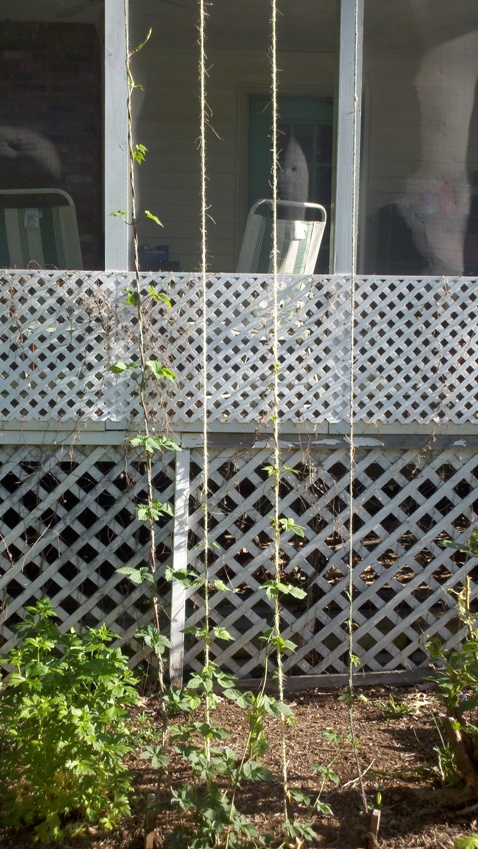
I can tell you that the second year is much different and the bines come up strong.  When the hops growing season gets started, a whole bunch of shoots come out of the ground.

A month later, ther bines at 10 feet tall.  I am (literally) running out of rope for these things.

My brother sent me a photo of his hop plant.  Last year, he didn’t get much growth and no cones.  I think this year will be a little different.

Mt. Hood Hop Bines

Draining the Kettle

I have been brewing with a converted keg as my kettle for a couple years now.  I really enjoy the size of it and sturdiness.  One thing that chronically plagues me is my draining process.  I have a weldless bulkhead fitting through the side.  I used to just make a 7 gallon final batch size so I could drain out of it 5 gallons.  But I got tired of leaving ~28% of my batch behind.  So I have worked with several types of dip tubes.  I have used a copper tube to the center of the kegs base.  That set up works, but I am also pulling all the cold break and hop debris into the fermentor.  I have tried a copper dip tub that suck from the side of the kettle, but you still leave about 15% of the batch behind, and pull some break and hop debris.

I am also considering upgrading to a plate chiller.  Mainly to save time.  Many friends of mine have them and it cuts a good 30-40minutes out of the brew session.  I need that with the family situation making it tough to find time to brew.  But to use one of those you really need to clear your wort of most all the hop debris.

I was using a small 9 inch false bottom and a centered stainless dip tube for a few batches.  That worked great when using whole hops.  But the thing seems to twist sometimes under the weight of my immersion chiller, so you end up sucking hops again.

There is also the issue of losing siphon when the wort falls below the level of the ball valve in the kettle.  I used to have a polysulphone disconnect system on the valve and a piece of tubing running into the kettle.  But the tubing had an ID of 3/4inch.   As wort flow slowed toward the end of the batch, air would sneak up the tube and break the siphon and stopping the flow.  I think I fixed that by going to a brass 1/2inch ID barb fitting with 1/2inch tubing. (Which I actually like better for sanitation issues behind the disconnect in the valve port).

On my last batch I used a homemade hop-stopper.  Similar to one of these:

100_1844

That worked well but I still pulled some air from somewhere and lost flow prematurely.

So why am I putting this long post up?  Well I was wondering how others are separating their wort from their hop debris.  More importantly, am I the only idiot with siphon issues out the dip tube in the kettle?

Vienna Malt

Since I am using Vienna Malt for the first time in the Brew Dudes’ First Annual O-fest Brew Off, I thought I would research it and put up a profile post about it.

Historically, this malt variety is the foundation of the Vienna lager, which has a pretty interesting history in itself…but that’s another post. The developer of that beer style was named Anton Dreher and he spent time studying brewing around Europe including England. Once he got back to Austria, I read that he implemented his knowledge of English malting techniques into his beer brewing – which leads me to believe this knowledge birthed Vienna malt.

This variety is similar to Munich malt where it can be used as a base malt, but most recipes pair them with a Pilsner malt.

Because it is kilned at higher temperatures, Vienna malt will bring a little more flavor and color to your beer than a Pilsner malt would. Let’s get into the specifics:

Flavor: Fuller, deeper malt flavor – more grainy

Color: 3 to 3.5°L – Provides a nice golden color to your beer.

Body: N/A

Use: Typically, it’s used as a base malt for Vienna or Märzen style lagers or as a percentage of the base malt total.

Watch out for Homebrewers

Last Thursday I was standing outside my house at the corner talking with my brother-in-law (who lives next door).  We were watching the sun set and chatting about the kids running around.  We are new to the neighborhood so the neighbor that lives across the street comes out to say hello.  She introduced herself and her baby girl mounted on her hip.  Nice start.  After the conversation progressed a little bit she startled me with the following exchange:

Neighbor: “Were you doing something in your garage last night?”
Me: “Um…Yes but it depends on whose asking?”
Neighbor: “Were you brewing beer?”
Me: “Yes.  Yes I was brewing beer.”
Neighbor: “I thought so.  My husband and I are big craft beer fans!  We just built his mash tun last fall and he brews beer too!”

I was psyched and blown away.  Now I haven’t had a chance to talk with said ‘husband’ yet. He was at work/school; apparently finishing off a Masters Degree in Electrical Engineering. However, I have exchanged several friendly nods while were were both snowplowing our driveways over the winter. I told her that any time you see the garage door open and the kettle steaming away, come on over and see what’s brewing. Maybe soon, I’ll finally get to my kegerator finished and I’ll be able to serve up some brown ale if they stop by. 

The moral or the story is:  Always keep an eye out for homebrewers.  Our ranks are growing!

BREW ON!

American Brown Brew Log 2

Here are some pics in slideshow format of my recent brew session.  Enjoy.

Page 210 of 322

Powered by WordPress & Theme by Anders Norén