Brew Dudes

Homebrewing Blog and Resource

The hobby of homebrewing beer

Vienna Lager Brew Session

It has snowed here in Massachusetts. And it has snowed. And it has snowed. In fact yes, it is even snowing now. It’s tough to brew with so much snow. Are you snowed in? Do you brew in the cold? Well, if not and you are looking for a fix we have recorded a brew session for you. Grab a pint sit back and pretend you are getting your own brew on!

Now before the comments start rolling in – This session was recorded after only our first storm. It has dumped on a twice more with several little storms in between. So don’t dismiss our backyard with only 12-18 inches in it. Presently my brew area (not pictured) is 5 feet deep in the snow.

John has been jamming with Vienna lager for quite some time and it is good!!! He’s back at it in this video with his basic steps. It’s also nice to get a glimpse of someone else equipment setup and see if they do something different from you.

The primary challenge with brewing in these conditions is estimating the boil off rate. When it’s cold and the air is dry, the rate tends to be a bit higher. If you don’t account for it you, can overshoot your gravity by losing too much water and that can throw off you hops to malt ratio/balance.

John also experienced a new winter challenge and that involved being shipped yeast that froze in transit! Not sure how to avoid that one, but he recovered well by building starters for the yeasts he had and looking to be sure they took off. When he knew he still had good yeast, the session was on.

Are you brewing in waist deep snow? Do you brew like mad in the fall so as to not need to brew in the winter or maybe you live someplace warm and dry year round. Tell us about it in the comments below!

BREW ON!

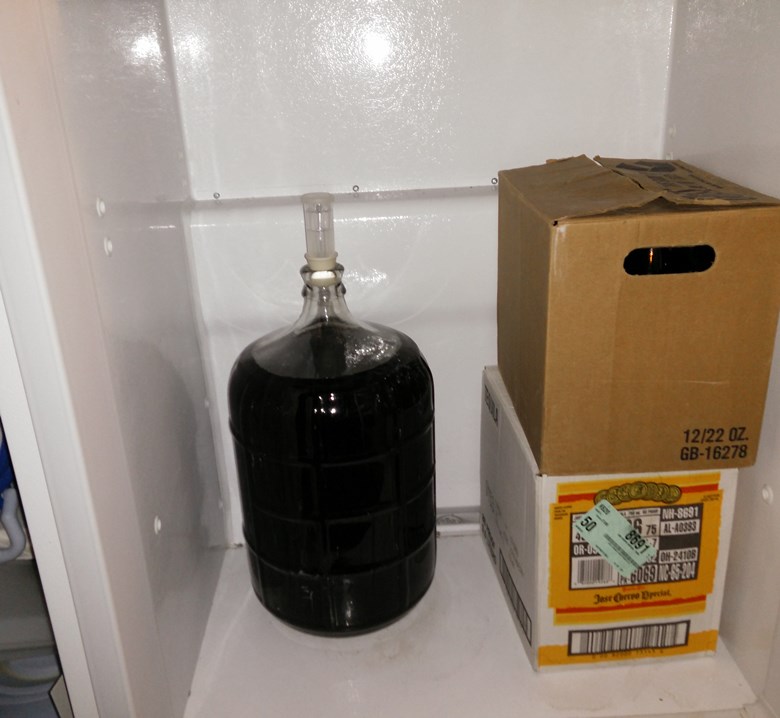
Here’s some photos of the lager lagering away:
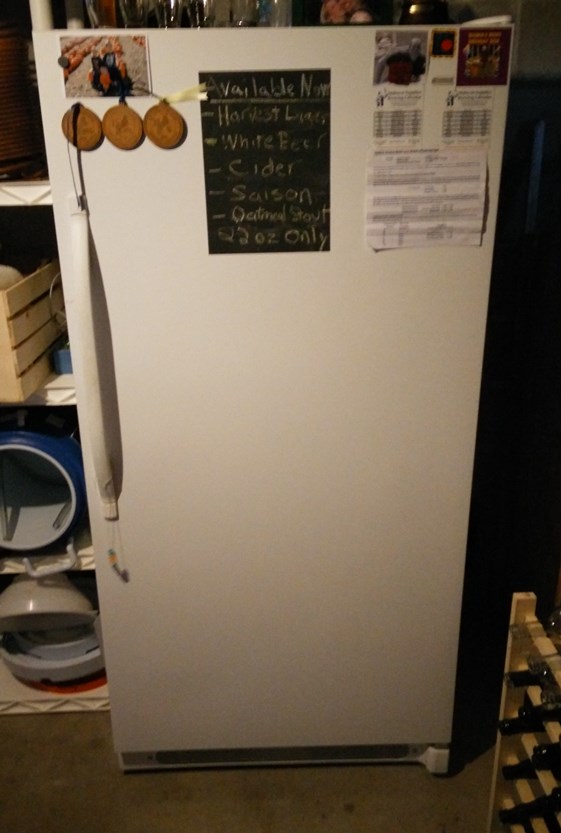
Beer Fridge

Lager Lagering Away

2015 Cider Tasting

John and I both made a couple batches of cider in the fall of 2014.

He has his method. I have mine.

We tasted them side by side and discussed our choices of pressed juice, fortifications, yeast and bottle conditioning.

Nothing better than crisp refreshing cider to mix it up once and a while.

I have found that some people like cider and some people hate cider. Cider isn’t my favorite beverage, but I’ve discovered some interesting facts about cider.

I don’t know of a commercial cider that I really enjoy. There are some new cideries opening up around here from time to time; and I occasionally seek out their products to see what’s new and different and yet none of them thrill me.

I have discovered that making cider at home, similar to home brewing, you can craft the beverage to be what you like. Just like tweaking a favorite beer style to fit your taste buds, cider making has some leeway as well.

For my ciders, I have gotten the most success out of adding a little dry malt extract to them. Using a little DME tends to help retain a little gravity at the end of the ferment. Not all the DME is fermentable which leads to a cider that has more of a 1.005 finish rather than something lower than that or even below 1.000.

That touch of residual sweetness helps carry the apple flavor when most of the aromatics and such have been driven off by fermentation.

John prefers to use some honey to fortify his cider. Honey is nearly completely fermentable, just like the pressed apple juice is. When John doesn’t have in residual sweetness he makes up for with floral character from that honey. A nice honey fragrance tends to trick my palate into thinking the cider is sweeter than it is. Depending on the source of your honey you can get some very interesting notes in the cider. Being a mead maker as well, John has developed a keen sense on how to use honey and what its contribution may be.

Fortifying your pressed juice to make cider with an ancillary sugar source is somewhat necessary as well. You can very quickly ferment your juice straight up. It will create a decent cider but the alcohol level will be fairly low. You get a session cider if I can borrow the term. I think that we expect cider to be a little stronger than 4% though. There is something about their being 8% ABV in the beverage that helps carry the flavor a bit and enhances the experience.

Ultimately, it’s about what you like. I am a die hard beer guy so I think that touch of malt in my cider satisfies me when I a craving something other than beer (either to brew or drink). The nice thing about cider making is that its pretty much as simple as putting yeast into cider and stirring. A little yeast nutrient doesn’t hurt either.

Let us know about your cider making tips and tricks.

Cheers!

What is Hop Bursting?

Can you put too many hops in a beer? How do you know when enough is enough? These questions brought us to some thoughts on hop bursting… so we shot a video.

Hop bursting is not a new technique per se, but for a couple dudes that tend to brew malt forward beers it was an interesting discussion for us. Over the last couple years we’ve certainly been exploring hoppy styles and hop usage a little more. John with his homegrown hop beers and me with some no chill IPA experiments (Falconer’s Flight hop blend). We’ve also been thinking about hops a little more during our discussion on water chemistry.

Hop bursting is the practice of adding a much larger than normal amount of hops at the end of the boil. I guess, in the strictest sense, it involves only adding hops at the end of the boil. The idea being that even though you only get a few IBUs at the end of the boil, by adding more hops you are getting enough IBUs to balance the beer. That big burst at the end preserved the hop oil content really giving a beer with tons of flavor and aroma.

We’ve never hop bursted before but is sounds interesting. Before we try it, we’ve wondered at what point is too much hops… Certainly just adding your normal 3-4 oz of hops at the end of the boil isn’t going to be enough, but is 12 oz or 16 oz too much???

I think it depends on your system and your brewing process. We all brew a little differently and we all have slightly different equipment set ups. (At least until the government starts subsidizing Blichmann kettles in every home.)

Therefore, the question of how much is too much need to be determined empirically.

If you are going to try hop bursting (or any recipe modification) you need to go into it expecting that plans may get you close to what you want but you’ll need to re-brew it again once you taste it.

It is part of the process of tuning in a recipe or technique. There is no direct answer sometimes; you need to determine how it works for you on your system.

I’d say the goal of a good hop bursting beer is to minimize vegetal off flavors, while maximizing every thing that it great about your hops. Keeping the bulk of that much hop debris out of the fermentor is likely key, not to mention reducing little hop bits in the glass as well.

We may experiment with some hop bursting in a few coming brews.

Do you have any experience with hop bursting?

How much hop material have you added to kettle before without it becoming a limiting factor in your process?

Where to the diminishing returns start?

Leave us a comment either here or on our YouTube channel.

BREW ON!

Equinox Hops SMaSH Beer

The third in out series on SMASHing with the newer hop varieties. This week’s contestant is Equinox Hops! John said that this was the most dynamic and pungent smelling hop pellet he’s ever experienced right out of the pouch. Check out the video and let us know about your experience (or lack of…) with Equinox hops.

On first impression, I could tell that Equinox was the strongest of the three we’ve tried (see more about the El Dorado SMaSH results and the Mosaic SMaSH results). The initial aroma was certainly a ripe, almost over ripe, juicy green melon. I found that there was a interesting white grape quality, slightly tart like, more like grape skin than the fruit proper.

I also got an underlying green onion/scallion thing. Not bad, sort of holding all the other aromas together.

The bitterness was mild to moderate. It was certainly in second place in intensity vs the other two. The bitterness doesn’t linger.

It still presents itself with the grapefruit citrus pith quality we’ve all come to expect from American hops.

There is a mild resin quality but not super sticky.

The flavor is where this hop does its thing.

The grape skin thing was dominant.

The melon quality held up well in the flavor.

There was a grassy quality in there too to go along with the resiny bitterness.

There was a definite green pepper presence. The flavor intensified as it warmed up as well.

I’d describe this note as being in between a green bell pepper and a jalapeño pepper (just the flesh not the heat).

Commercially, this hop is described as citrusy with lemon and lime notes. It is supposedly tropical with notes of Papaya.

Distinctly, some describe it with apples, cherries ad mango like, which is a weird descriptor trio as I don’t think those are even remotely related to each other.

I didn’t get any of that but we did maybe suspect my grape skin thing was related to the cherry idea.

Green pepper was most definitely in the commercial descriptors and we tasted it for sure. Not sure if it’s something I really want to promote in my beer.

In the end, we both agree that this hop would work well in the middle of the boil, perhaps blended with something more resinous and dank to help balance that green pepper thing. This hop is worth trying out in your next American pale ale.

BREW ON!

El Dorado Hops SMaSH Beer

We continue the new hop SMASH beer journey with El Dorado hops. Be sure to check our our previous SMASH review of Mosaic Hops.

My first impression of the aroma from the El Dorado SMaSH beer was candied ginger and candied orange peel. It was unique and inviting. I also pulled some raspberry notes as it had a darker fruit character. Underneath it all was the sense of fresh cut grass.

The bitterness from these hops was very mild. For 15% AA hop, it was very surprising. The bitterness was slightly resiny but it did not linger like other super dank American hops. It was certainly nothing like the bitterness we got from Mosaic hops.

The flavor of these hops carried through with the cut grass taste. There was still a pleasant citrus and berry flavor that I more described as a raspberry lime rickey thing. It was sort of sweet but driven by a distinct green citrus flavor.

Commercially these hops are hyped up to be strong in tropical and stone fruit with maybe some pear or watermelon notes. I can sort of see that interpretation after the fact, but my palate really leaned more towards a berry and citrus complement, rather than mangos or papaya.

Overall though, we found the hop to be very pleasant and unique. As it warmed we were drawn back in for more. The aroma seemed to change a little each time you sniffed it. I’d wouldn’t use this hop all by itself again. But, like our Mosaic experience, it would be a great complement for blending with other varieties.

Again, the hop schedule for this SMaSH beer was as follows:

1 ounce of hops for a 1 gallon batch.

.25 ounce at 60 minutes to go in the boil.
Another quarter of an ounce at 10 minutes to go in the boil.
A quarter of an ounce at flame out
The remaining .25 ounce was added to the fermentor with 3 days to go in fermentation.

What say you? Have any experience with El Dorado hops?

Be sure to leave a comment and let’s us know what you think.

Cheers

Page 122 of 322

Powered by WordPress & Theme by Anders Norén